

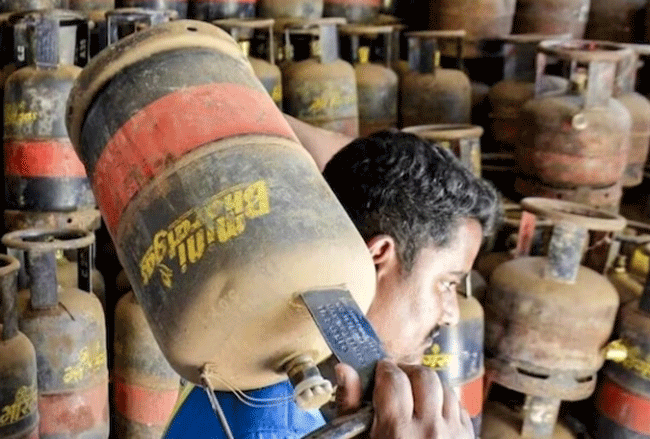
New Delhi: Union Government announced that domestic cooking gas prices in the country remain among the lowest globally, despite severe international supply disruptions and rising import costs. According to data released by the Ministry of Petroleum and Natural Gas, Indian households are paying significantly less for liquefied petroleum gas (LPG) compared to neighbouring countries and advanced economies like the United States, Australia, and Canada.
Following a recent price revision, general consumers in Delhi will pay 942 rupees for a 14.2 kilogram domestic cylinder, while beneficiaries of the Pradhan Mantri Ujjwala Yojana (PMUY) will pay an effective rate of 642 rupees. This comes at a time when the actual cost of supplying a single domestic cylinder has surged past 1,600 rupees due to external geopolitical factors. The government is currently absorbing an under-recovery of approximately 700 rupees per cylinder to shield consumers from high international market rates.
In comparison, a similar 14.2 kilogram cylinder costs 1,046 rupees in Pakistan, 1,207 rupees in Nepal, 1,225 rupees in Bangladesh, and 1,241 rupees in Sri Lanka. In western markets, prices are much higher, with the same quantity costing approximately 1,755 rupees in the United States, 1,765 rupees in Australia, and 2,411 rupees in Canada.
The sharp rise in import costs stems from the closure of the Strait of Hormuz in late February, which heavily restricted exports from the Middle East Gulf. The Saudi Contract Price for LPG, which acts as the international benchmark for India’s imports, jumped 46 percent from 542.50 dollars per metric tonne in February to 790 dollars per metric tonne in June. While commercial LPG prices for businesses are adjusted monthly based on these market shifts, the government has chosen to buffer the domestic sector.
Despite the fact that over half of India’s LPG consumption relies on routes through the Strait of Hormuz, officials confirmed that energy supplies remained stable. India was one of the few nations that kept its energy cargoes moving throughout the maritime crisis. Indian-flagged tankers successfully navigated the strait without paying tolls, preventing domestic shortages or supply chain breakdowns.
To manage the crisis, the government scaled up domestic LPG production by more than 60 percent, increasing outputs from 32 to 52 thousand metric tonnes. Sourcing was also diversified to non-Hormuz suppliers like the United States, Canada, and Algeria. On the demand side, the government encouraged a shift toward piped natural gas and clamped down on illegal cylinder diversion by raising one-time password based delivery verification to 90 percent.
The financial impact of these protective measures is substantial. By the end of the last financial year, the cumulative under-recovery on domestic LPG reached 60,000 crore rupees, up from 41,338 crore rupees the previous year. To help cushion this financial weight, the Union Cabinet approved 30,000 crore rupees in compensation for public sector oil marketing companies. This financial support is separate from the Ujjwala subsidy, which directly provides a 300 rupee credit per cylinder on the first four annual refills for more than 10.58 crore eligible connections.