

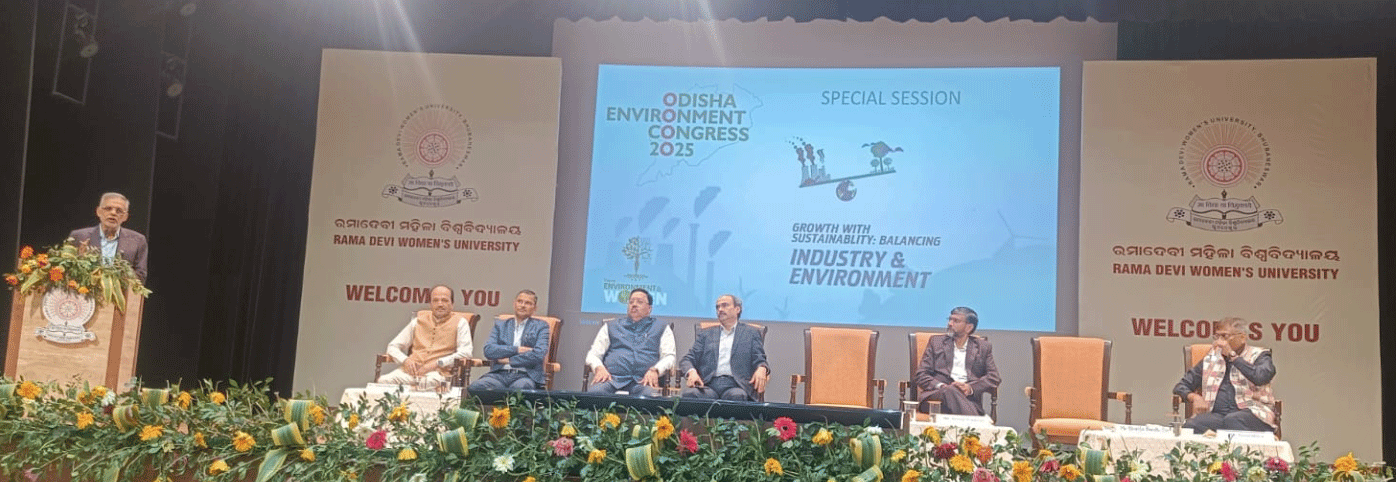
The 16th Odisha Environment Congress concluded its final day at Rama Devi Women’s University in Bhubaneswar on 22nd December 2025, centering on the critical theme of Environment and Women. The three day event served as a platform for policymakers, industry leaders, and academic experts to discuss the disproportionate impact of climate change on women and the necessity of gender justice in environmental governance.
The valedictory session featured Shri Hemant Sharma, Additional Chief Secretary to the Government of Odisha, as the Chief Guest. In his address, he emphasized the state’s strategic shift toward balancing rapid industrialization with ecological sustainability. He noted that while Odisha aims to contribute significantly to national steel and metal production, the government is incentivizing industries to adopt green technologies and renewable energy sources. He highlighted that any investment in environmentally sustainable technology is now treated as a new investment under the Industrial Policy Resolution, making it eligible for state subsidies.
Dr. Prabodh Mohanty, President of the Utkal Chamber of Commerce and Industry Limited (UCCIL), attended as the Guest of Honour. Dr. Mohanty spoke on the evolving role of the industry in environmental stewardship. He advocated for a robust logistics infrastructure, specifically the development of inland waterways, to reduce the carbon footprint of mineral transportation. He reinforced the commitment of the industry to align with Odisha’s Vision 2036, which prioritizes sustainable growth alongside economic expansion.
Representing the Indian Chamber of Commerce (ICC), Chairman Rajib Sekhar Sahoo provided insights into the intersection of finance and climate action. He stressed the importance of corporate social responsibility (CSR) in fostering community resilience and underscored that environmental protection must be integrated into the state’s economic roadmap to ensure justice for future generations.
The congress sessions highlighted alarming statistics regarding the representation of women in environmental roles, noting that while women are the primary managers of natural resources in rural areas, they remain underrepresented in formal forest and environmental services. The discussions concluded with a call for more inclusive policies that empower women as leaders in conservation and climate adaptation efforts.