

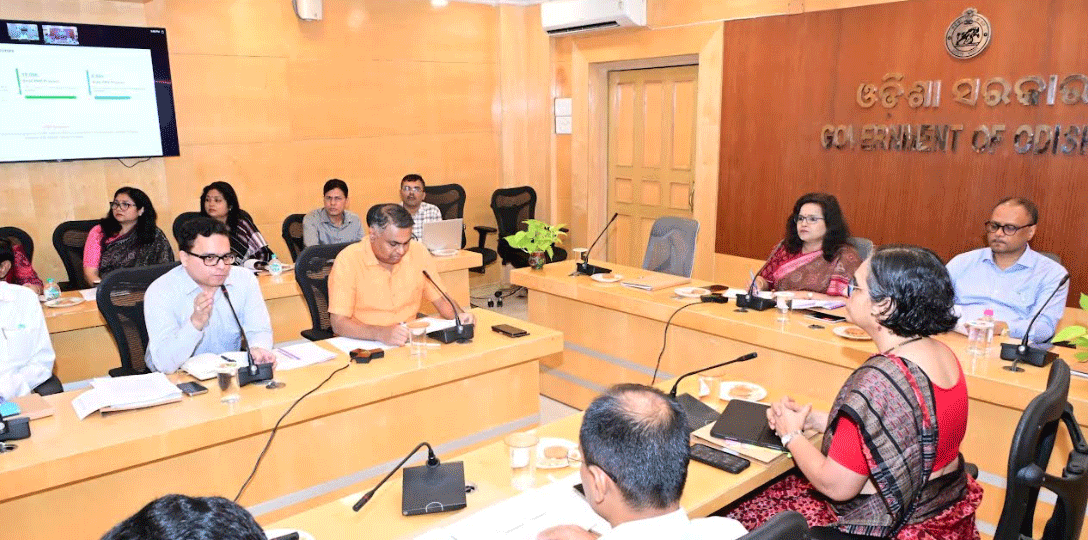
Bhubaneswar: The 19th Governing Committee meeting of the Odisha Water and Sanitation Mission (OWSM) and the State Apex Committee meeting of the Jal Jeevan Mission were held at the conference hall of Lok Seva Bhawan under the chairmanship of Chief Secretary Smt. Anu Garg. The session focused heavily on executing reformative steps to ensure the successful implementation of Jal Jeevan Mission 2.0 and ensuring the sustainability of safe drinking water services.
The high-level meeting was attended by Development Commissioner and Additional Chief Secretary Sri Deo Ranjan Kumar Singh, Water Resources Department Principal Secretary Smt. Subha Sharma, and Panchayati Raj and Drinking Water Department Commissioner-cum-Secretary Sri Girish S.N., alongside secretaries from various other concerned departments who serve as members of the committee.
During the proceedings, the Director of Drinking Water and Sanitation, Sri Vineet Bhardwaj, presented a detailed report regarding the operational progress of OWSM, measures taken to improve the quality of drinking water, the status of ongoing execution plans, and various institutional reforms.
The updates presented during the meeting highlighted significant progress in the state’s water infrastructure. Out of 207 mega piped water supply projects sanctioned in the state, 42 have been fully completed. Another 44 mega projects have successfully completed the construction of their intake structures and water treatment plants, allowing partial or full water supply to commence. Monitoring mechanisms have been tightened across the board to ensure all remaining mega projects are completed quickly.
In terms of small-scale infrastructure, out of 19,086 small drinking water projects, 18,737 have been completed, with the rest scheduled to be finished by October this year. Similarly, out of 8,863 solar-powered water projects, 6,637 have been completed, and the administration has set a deadline of November 2026 to wrap up the remaining installations.
To strengthen drinking water management under Jal Jeevan Mission 2.0, the committee deliberated on long-term operation and maintenance policies as well as structural reforms. Key topics included strengthening technical support systems at the village and Gram Panchayat levels, building institutional transformations, and establishing tripartite agreements between village water sanitation bodies, Gram Panchayats, and project construction agencies. Discussions also covered citizen-centric water quality monitoring, water source sustainability, water security, digital governance through Sujalam Bharat, and community-driven water management.
Under the Sujalam Bharat initiative, more than 94,000 Sujal village identification profiles have been generated so far. Tasks relating to geo-tagging, project monitoring modules, and setting up the Command and Control Centre are scheduled to be completed by December this year. The committee also reviewed skill development training for Har Ghar Jal field workers, human resource allocation, financial sustainability, research, and innovation.
Under the Har Ghar Jal scheme, tap water supply has successfully reached 16,724 villages, out of which 12,484 villages have already received official certification for their water supply systems. The target is to complete the certification for the remaining villages by October. Based on data from the Jal Seva Assessment, the availability of drinking water across different districts was closely reviewed alongside state upgrade plans. The committee also reviewed the approval of drinking water projects and the provision of cent percent household water connections under the PM-JANMAN and DAF-JJYU initiatives.
Furthermore, the progress of the Swachh Bharat Mission (Grameen) was assessed. It was reported that more than 96 percent of the villages in the state have been officially declared as ODF Plus Model villages. The committee gave strict directives to prioritize solid and liquid waste management across these rural regions.