

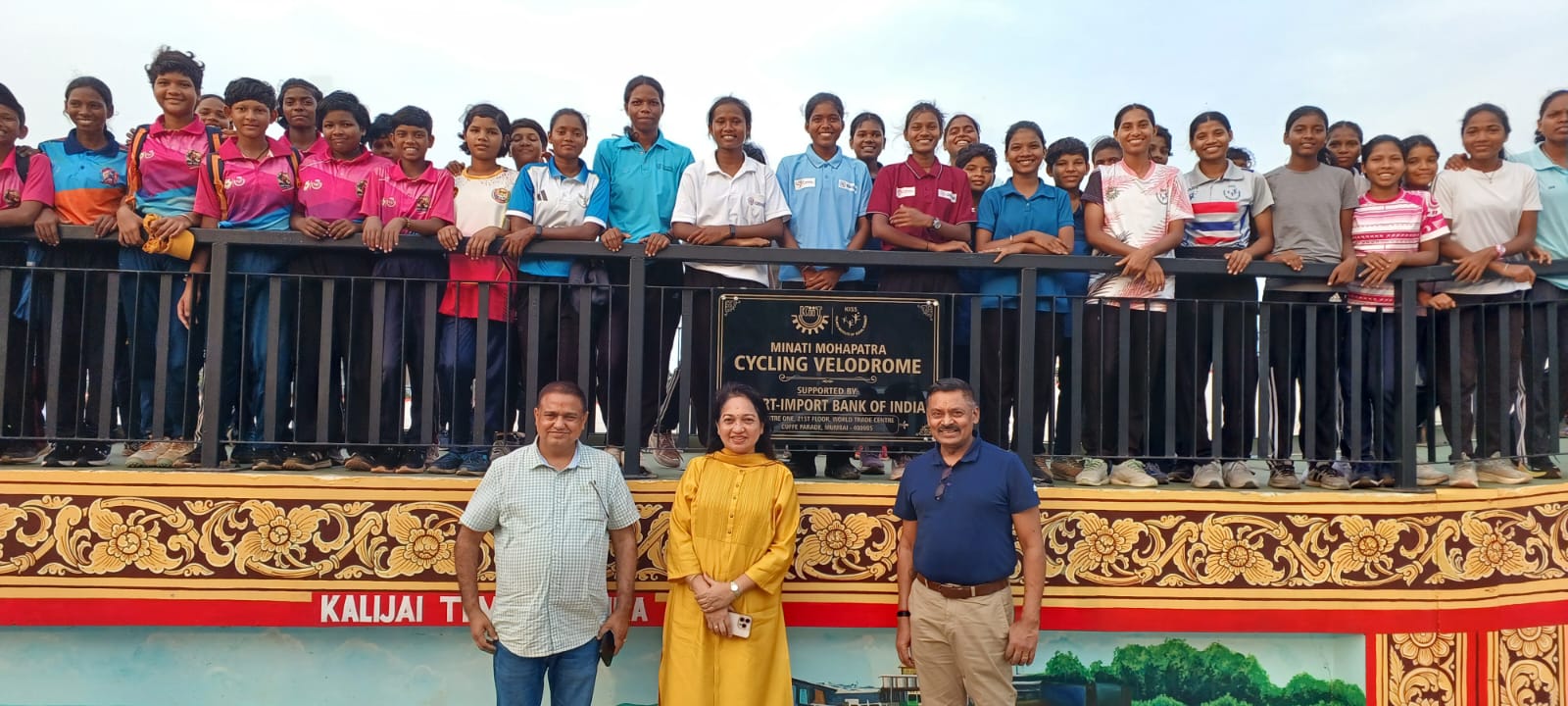
Bhubaneswar: In order to boost the country’s sports infrastructure, India Exim Bank has extended its corporate social responsibility (CSR) support to establish India’s first concrete cycling velodrome at the Kalinga Institute of Social Sciences (KISS) in Odisha.
The state-of-the-art 250-meter track has been officially named the Minati Mohapatra Cycling Velodrome, honoring one of the nation’s pioneering female athletes and Odisha’s first Arjuna Awardee in cycling. The corporate-institutional alliance aims to create a highly accessible ecosystem for emerging tribal and underprivileged sportspersons, bridging the gap between grassroots talent and international training standards.
According to representatives from India Exim Bank, the funding project reflects a core philosophy that enabling national dreams requires investments extending beyond standard international trade and economic development. The corporate leadership expressed pride in providing future generations of athletes with the specific tools needed to grow, compete, and excel on a global stage. By anchoring this high-performance facility at the KISS campus, the bank intends to directly empower thousands of young students with access to elite infrastructure that was previously unavailable in the region.
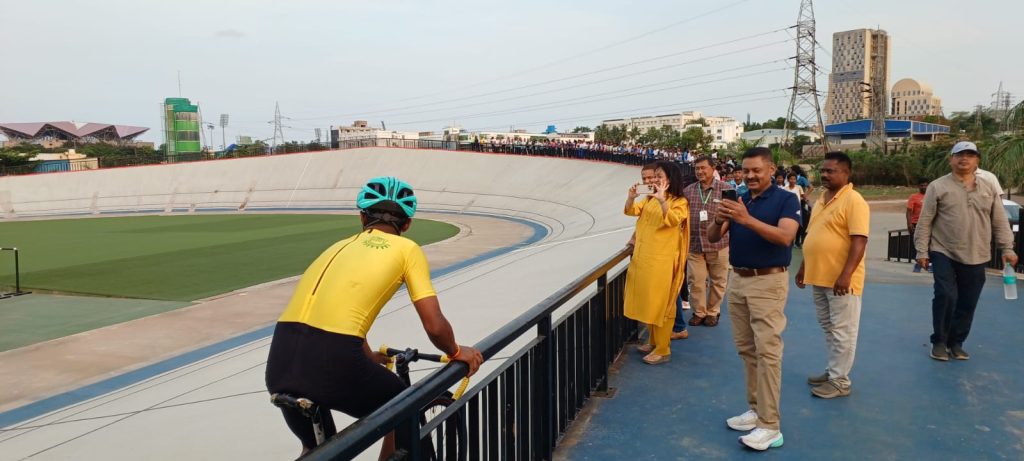
The decision to establish the velodrome comes as a strategic move to address a critical deficit in India’s track cycling pipeline, which heavily relies on specialized concrete geometries for speed and safety. The facility is expected to serve as a vital training hub not only for the resident students of KIIT and KISS but also as a foundational venue for regional and national track cycling events.
The naming of the venue celebrates the historic accomplishments of Minati Mohapatra, an eight-time national cycling champion who dominated the sport throughout the 1970s. Mohapatra made history in 1980 by becoming the first sportsperson from Odisha and the first female cyclist in India to receive the prestigious Arjuna Award.
At the unveiling ceremony, sports officials and community leaders noted that her name on the infrastructure acts as a visible symbol of inspiration and aspiration for young women and aspiring athletes entering track sports. Mohapatra, present at the dedication, expressed deep gratitude for the recognition, describing it as a monumental milestone for the sport of cycling in eastern India.
The initiative aligns closely with national efforts to cultivate a comprehensive sports culture across educational institutions, ensuring that athletic training moves in tandem with formal academic learning. Track cycling requires unique spatial and technical conditioning, and India Exim Bank’s capital contribution directly targets this infrastructure gap.
By facilitating access to a world-class training ground, the bank and the administrators at KISS hope to systematically discover young talents, polish their capabilities under professional guidance, and ultimately strengthen India’s competitive standing in track cycling for decades to come.