

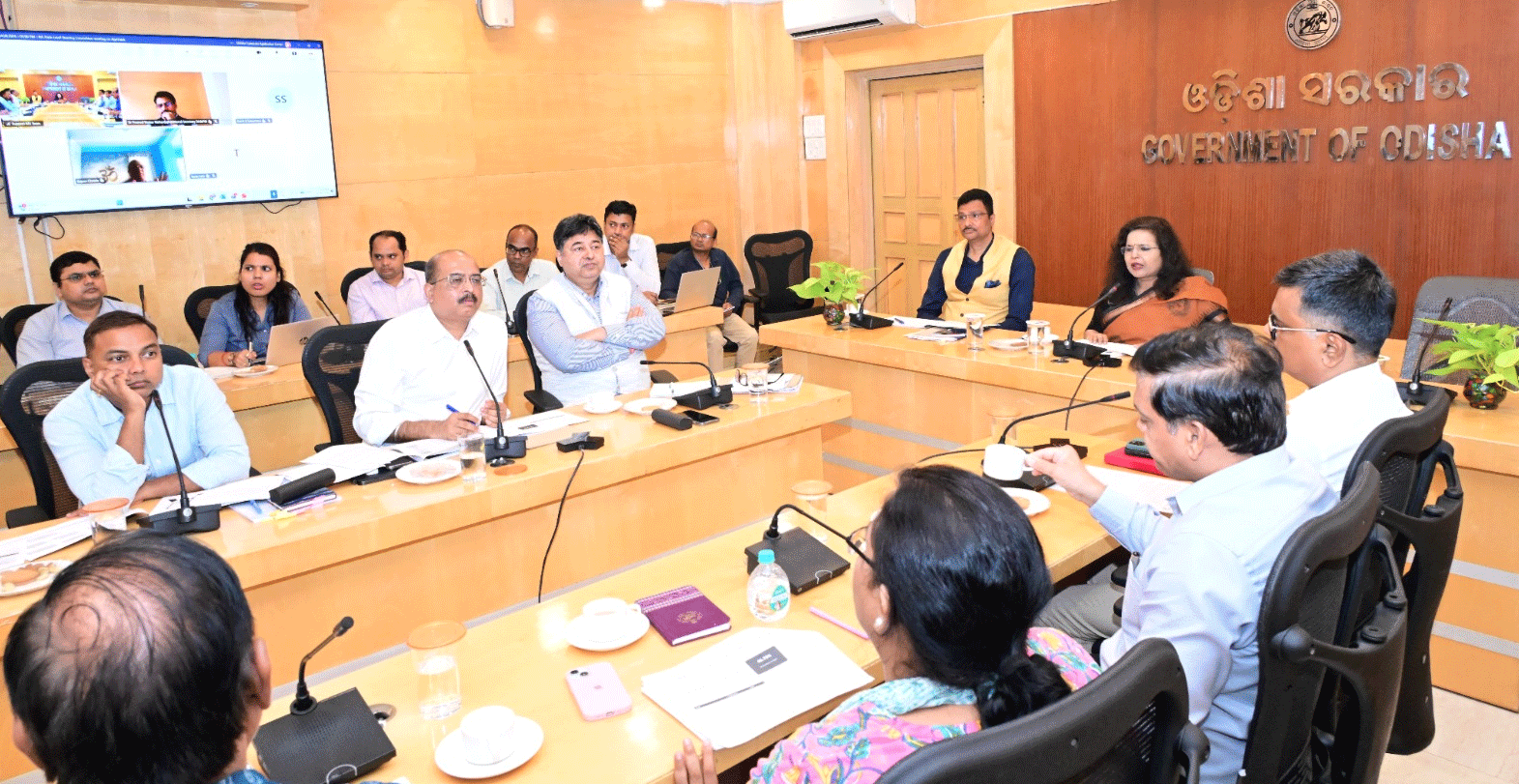
Bhubaneswar: The eighth State Level Steering Committee meeting of AgriStack Odisha was held under the chairmanship of Chief Secretary Smt. Anu Garg at the conference hall of Lok Seva Bhawan on Tuesday, August 4. The meeting focused on farmer registration and the implementation of the Digital Crop Survey across the state.
Dr. Arbinda Kumar Padhee, Additional Chief Secretary of the Revenue and Disaster Management Department, Principal Secretary Finance, Shri Sanjeeb Kumar Mishra, Principal Secretary Food Supply and Consumer Welfare, Shri Sanjay Kumar Singh, Secretary Agriculture and Farmers Empowerment, Shri Sachin Ramachadra Jadhav, Secretary Cooperation, Shri Rajesh Prabhakar Patil, Secretary Fisheries and Animal Resources Development, Shri Prem Chandra Chaudhaury and others attended the meeting.
Dr. Pramod Kumar Meherda, Additional Secretary to the Ministry of Agriculture and Farmers Welfare, Government of India, and Shri Rajeev Chawla, Chief Knowledge Officer of the AgriStack Mission, participated in the deliberations virtually.
Secretary, Agriculture and Farmers Empowerment Department, Shri Sachin Ramchandra Jadhav, presented the current progress of farmer registration and digital crop surveys in Odisha. Out of a target of 4,438,559 farmers across 30 districts, a total of 2,075,683 farmers have been registered so far, with registration ongoing. Jharsuguda district recorded the highest completion rate at 75.78 percent. Between January and July 2026, approximately 700,000 farmers were enrolled, with May 2026 recording a peak monthly registration of 229,700 farmers. The meeting also reviewed observations, decisions, and action items originating from the previous survey progress meeting held on December 11, 2025.
AgriStack represents a major step toward digital transformation in the agriculture sector, implemented by the central government in collaboration with state governments. Under this initiative, farmers receive a unique digital identity, known as a Farmer ID, which connects them directly to a unified platform. This platform facilitates smooth access to various government schemes, agricultural advisories, crop insurance, institutional credit, and input assistance, ensuring transparent, targeted, and speedy service delivery.
The Government of India has proposed establishing an AgriStack Commissionerate. The committee discussed creating a state-level commissionerate in Odisha headed by a Director-level officer as Commissioner. This team will include senior officials and technical consultants from the Revenue, Agriculture, and Electronics & IT departments. Operationally, district-level committees will function under District Collectors, block-level committees under Tehsildars, and a technical-operational Project Management Unit (PMU) will operate at the state level.
To ensure that actual farmers, sharecroppers, and active cultivators are properly identified and integrated, the state will formulate a Standard Operating Procedure (SOP). This SOP will help clear pending applications, finalize registrations, and ensure that all eligible farmers gain access to welfare schemes and benefits. Chief Secretary Anu Garg instructed a joint committee comprising representatives from the Revenue, Food Supplies and Consumer Welfare, and Agriculture departments to draft this SOP. She emphasized completing all AgriStack tasks within stipulated deadlines, ensuring the authenticity and quality of farmer data, and maintaining routine progress evaluations.
The committee also reviewed the completion of the Rabi 2025 Digital Crop Survey and the readiness for the upcoming Kharif 2026 season. During the Rabi season, a total of 5,378,625 hectares were surveyed, identifying crops across 1,991,110 hectares, which accounts for roughly 37 percent of the surveyed area.
For Kharif 2026, the Digital Crop Survey is scheduled to begin on August 16, 2026. Training for field staff at the block and district levels will take place between August 5 and August 17. The field survey will run for 45 days to two months. To ensure accurate crop identification, surveys must take place at least one month after sowing and no later than 15 days before harvest.
Strict precision rules have been outlined for survey data collection. Surveyors must record data within a 10-meter boundary of plot limits, compared to the 20-meter limit enforced during the Rabi survey. Enhancements to the Artificial Intelligence features in the Digital Crop Survey mobile app were directed to enable real-time identification and verification of paddy and non-paddy crops. Block-level committees will meet weekly, and district-level committees will meet fortnightly to monitor survey progress.
Chief Secretary Smt. Garg noted that authentic data collected from the Digital Crop Survey will serve as a reliable foundation for crop insurance, agricultural planning, production estimation, and policy formation. She reiterated the directive for teams to complete all field activities within the defined timeframe while upholding high standards of quality and transparency.