

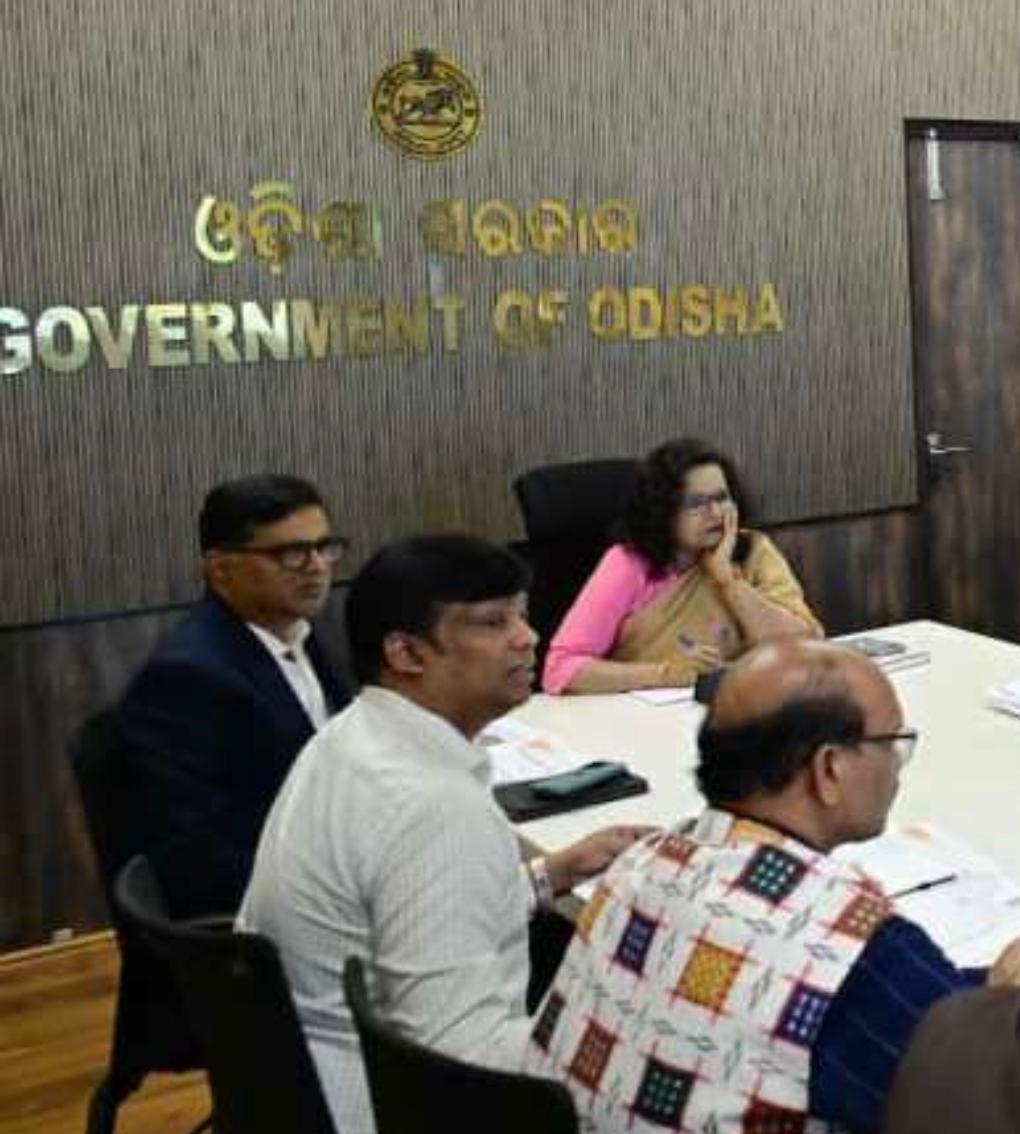
Bhubaneswar: In a significant demonstration of administrative oversight, Chief Secretary Sharimati Anu Garg has conducted a rigorous assessment of the Food Supplies & Consumer Welfare Department, emphasizing a socio-legal precision aimed at safeguarding the state’s agrarian foundations. She lauded paddy procurement process and PDS Modernization in the State.
The review articulated a narrative of moral urgency, focusing on the protection of the farming community through a technologically integrated and evidence-based procurement framework for the 2025-26 Kharif season. Principal Secretary Food Supplies and Consumer Welfare, Shri Sanjay Kumar Singh detailed out the latest on paddy procurement and PDS implementation.
The scale of the current operation is expansive, with 19,67,812 farmers registered and a total cultivation area of 61,67,414 acres documented. As of January 3, procurement has commenced across 18 districts, already yielding 11.84 lakh tonnes of paddy. This follows the substantial performance of the 2024-25 cycle, which saw the collection of 73.45 lakh tonnes of Kharif and 19.18 lakh tonnes of summer paddy. To manage this volume, the state has deployed 1,418 millers and utilizes 162 government godowns with a combined storage capacity of 6.5 lakh tonnes.
The administration’s systemic synthesis relies heavily on technical sophistication. Satellite imagery is being utilized to verify cultivation data, ensuring that the procurement process remains insulated from non-farmer intermediaries. The Chief Secretary’s recommendations focused on a layered causality of efficiency: ensuring quality verification, facilitating the prompt lifting of paddy by millers, and maintaining the rigorous standard of processing farmer payments within 48 hours. This digital ecosystem is bolstered by mobile applications for farmers and online vehicle tracking systems to streamline the logistical movement of grain.
Beyond procurement, the meeting addressed the moral imperative of universal food security. The state’s distribution network currently serves 3,27,83,673 individuals under the National and State Food Security Schemes. This massive undertaking is supported by 11,700 affordable food stores and a collaborative infrastructure involving 2,600 Primary Agricultural Cooperative Societies and over 400 Women Self-Help Groups.
To address the projected increase in yields, the Chief Secretary directed the establishment of additional “Smart Godowns” and the strengthening of grievance redressal mechanisms through dedicated help centers. This comprehensive strategy reflects a commitment to institutional transparency and the continuous modernization of Odisha’s food supply chain, ensuring that the welfare of the farmer remains the central pillar of state policy.
Furthermore, the Chief Secretary mandated the expansion of smart storage solutions to address the influx of grain, ensuring that the physical infrastructure of the state keeps pace with its digital and legislative advancements. This holistic approach reaffirms the administration’s dedication to a transparent, farmer-centric economy.