

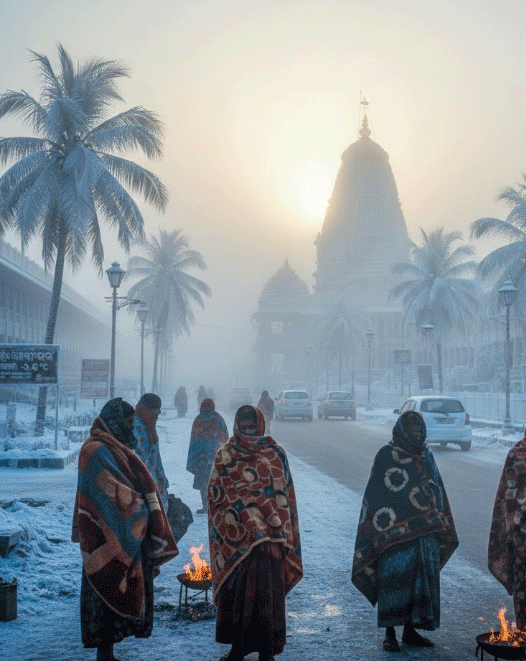
Bhubaneswar: Odisha is currently experiencing a severe climatic anomaly as an intense cold wave sweeps across the state, driven by the sustained influx of dry northerly and north-westerly winds from the Himalayan foothills. This meteorological event has triggered a systemic drop in minimum night temperatures, plunging vast regions into a state of acute thermal distress and necessitating urgent socio-legal and administrative interventions.
The India Meteorological Department has issued yellow warnings for several districts, including Jharsuguda, Sundargarh, Cuttack, Khordha, and Angul, as mercury levels have plummeted five to seven degrees Celsius below the seasonal average. On January 9, 2026, Rourkela emerged as one of the coldest locations in the Indian plains, recording a historic low of 3.6 degrees Celsius. Simultaneously, the core areas of Similipal National Park reported sub-zero temperatures, reaching minus 1 degree Celsius, a rare occurrence that underscores the shifting volatility of the regional climate.
The severity of the current cold spell is highlighted by comparative historical data. In Bhubaneswar, the temperature dropped to 9.4 degrees Celsius on January 8, 2026, matching a 74-year-old record set on January 3, 1952. This marks the capital city’s third-lowest January temperature since 1952, eclipsed only by the 8.6 degrees Celsius recorded on January 5, 1992, and 9 degrees Celsius on January 17, 2003. Cuttack also witnessed a significant event, recording 8.6 degrees Celsius, which surpassed a 40-year-old record of 8.7 degrees Celsius from January 1986.
The exceptional drop in temperature within Bhubaneswar is the result of a complex interplay between transcontinental atmospheric movements and localized geographic vulnerabilities. This climatic intensification is not an isolated event but a systemic manifestation of specific meteorological drivers.
The most significant immediate cause is the sustained inflow of dry, chilly north-westerly and northerly winds from the Himalayan foothills and the Indo-Gangetic plains. These winds act as a conveyor belt, transporting cold air masses directly into the heart of the Odisha peninsula.
Under the current conditions of clear, cloudless skies, the earth’s surface rapidly loses heat into the atmosphere at night. Without a cloud cover to act as a thermal blanket, this radiative cooling has caused the minimum night temperatures in Bhubaneswar to plunge more than 5°C below the seasonal norm.
Odisha’s unique physiography also plays a role. While the Eastern Ghats usually offer some protection, the current wind trajectory allows cold air to bypass these barriers and settle into the coastal plains. This explains why Bhubaneswar, which recorded 9.4°C on January 8, 2026, matched a historic record set in 1952. The absence of industrial heat islands sufficient to counter this massive advection of cold air has left the capital city uniquely exposed during this 2026 winter season.
The layered causality of this cold wave is attributed to a persistent anti-cyclonic circulation over central India combined with Arctic amplification and La Niña influences, which have funneled cold air pools into the peninsular region. The systemic impact extends beyond public health, posing a frost risk to rabi crops such as mustard and pulses in northern districts, and disrupting the livelihoods of outdoor laborers and tribal populations in the interior. In response, the state has implemented precautionary measures including school timing adjustments and the activation of community shelters to mitigate the heightened risk of hypothermia and respiratory illnesses among vulnerable demographics.