

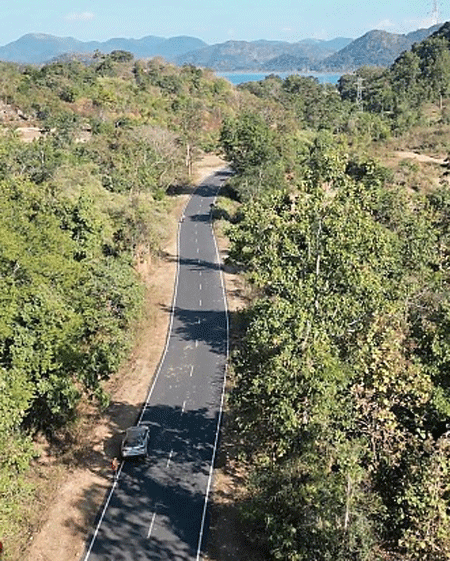
Bhubaneswar: The Union Cabinet, under the leadership of Prime Minister Shri Narendra Modi, has authorized the comprehensive widening and strengthening of National Highway 326 in Odisha. This infrastructure initiative targets the stretch from kilometer 68.600 to kilometer 311.700, upgrading the existing route to a two-lane configuration with paved shoulders. Executed via the Engineering, Procurement, and Construction (EPC) mode, the project carries a total capital investment of Rs.1,526.21 crore, with civil construction costs accounting for Rs.966.79 crore.
The systemic transformation of the Mohana to Koraput section is a matter of socio-economic urgency for Southern Odisha. Currently, the corridor suffers from substandard intermediate lanes, deficient curves, and steep gradients that impede the safe transit of heavy vehicles and stifle freight throughput to coastal ports. By implementing geometric corrections, realigning curves, and eliminating identified black spots, the project seeks to rectify these structural bottlenecks. Such interventions are projected to reduce travel time by up to three hours and shorten the distance by over twelve kilometers, directly lowering vehicle operating costs and enhancing road safety.
The economic narrative of this project is rooted in regional integration and systemic synthesis. While the financial internal rate of return is calculated at -2.32%, the Economic Internal Rate of Return (EIRR) stands at a robust 17.95%. This disparity highlights the project’s primary function as a vehicle for social equity rather than immediate fiscal profit. The upgrade provides critical last-mile connectivity to Gopalpur port, Jeypore airport, and major industrial hubs including NALCO, JK Paper, and Vedanta. Furthermore, it facilitates essential access to the Central University of Odisha and Koraput Medical College, bridging the developmental gap in tribal and aspirational districts.
The implementation strategy emphasizes technological precision and rigorous oversight. Construction will utilize advanced methodologies such as precast box structures and Cement Treated Sub-Base layers. Compliance and progress will be monitored through drone mapping and Network Survey Vehicles, supervised by an appointed Authority Engineer. The construction phase is mandated for completion within 24 months, followed by a five-year maintenance period, ensuring a seven-year commitment to structural integrity.
Ultimately, this intervention is a catalyst for inclusive growth across Gajapati, Rayagada, and Koraput. By linking these regions to the Raipur–Visakhapatnam corridor and neighboring Andhra Pradesh, the project fosters a more resilient logistics network. Beyond the immediate generation of employment for skilled and unskilled labor, the improved connectivity serves a higher moral and legal purpose: ensuring that the citizens of southern Odisha, under the grace of Lord Jagannatha, are no longer isolated from the primary currents of national progress and essential public services.