

Cuttack: In a major legal victory for the Shree Jagannatha Temple Administration, the Court of the Member, Board of Revenue in Odisha has delivered a historic thirty-three-page judgment restoring fifty-seven acres of land worth around three hundred crore rupees to the accounts of Lord Jagannatha.
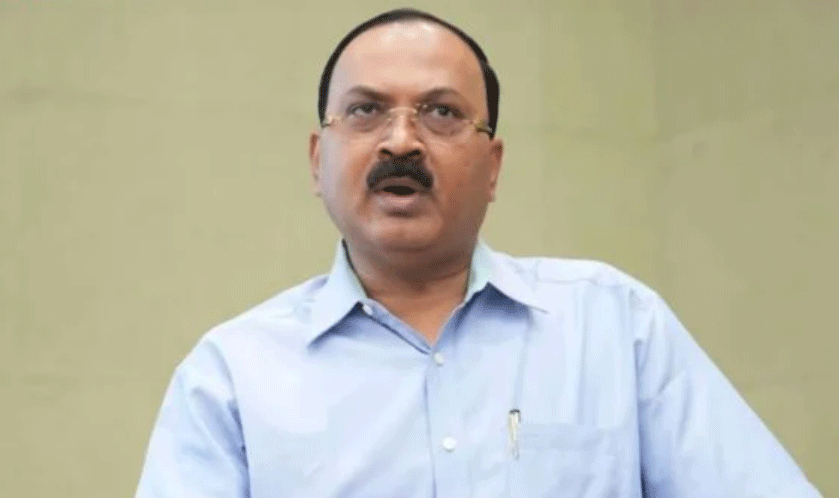
The Member of the Board of Revenue, Shri Satyabrata Sahu, who is an ardent devotee of Lord Jagannatha, passed the order after a swift hearing of two revision petitions, directing the Jatni Tehsildar to immediately correct the Record of Rights and register the land under the name of Shree Jagannatha Mahaprabhu Bije, Puri, represented by the Shree Jagannatha Temple Managing Committee.
The long-standing land dispute involves a massive patch of land located in the Kudiali mouza under the Jatni tehsil of Khordha district, which falls under the Ekharajat Mahal of the deity. The Shree Jagannatha Temple Administration contended that a long-term lease granted in the year 1951 for setting up an industrial unit was entirely illegal. Over time, relying on that unauthorized lease, the land had been registered in the government records under private parties, specifically Nilamani Dubey and others, alongside a firm named Gopabandhu Glass and Pottery Works Limited.
In its detailed ruling, the Court pointed out that under Section fifty-eight of the Orissa Hindu Religious Endowments Act of 1939, which was prevalent at the time, any lease of immovable temple property for a period exceeding five years mandatorily required the prior sanction of the Endowments Commissioner. The opposite parties failed to produce any evidence proving that such an approval was ever obtained. The Court clearly stated that merely because a lease deed happens to be registered, it does not automatically gain legal validity.
Additionally, the Judgment highlighted that the primary purpose of the original lease was the establishment of an industrial enterprise. However, court documents and a recent field verification report submitted by the Tehsildar revealed that the land has remained completely vacant, meaning no industry was ever built and the temple received zero financial benefit from the transaction. The Court reiterated that a Record of Rights does not generate an absolute ownership title but only serves as primary evidence of possession. If the initial basis of a record rests on an unlawful transaction, the revisional authority holds absolute power to correct those records.
The ruling also cited a significant Supreme Court of India precedent from the case between the Shree Jagannatha Temple Managing Committee and Sidha Matha, noting that special statutory provisions aimed at protecting temple properties must always take precedence. Finding the Record of Rights prepared in 1965 to be full of legal errors, the court ordered the Jatni Tehsildar to revise the entries immediately and record the fifty-seven acres as Anabadi Puratana Patita under the ownership of the deity.
According to legal experts, this landmark Judgment will serve as a vital precedent for safeguarding religious and public endowments in the future, even as the state revenue administration steps up measures to legally protect the extensive immovable properties of Lord Jagannatha across different districts.
Senior Advocate Shri Ambika Prasad Mishra, who managed the case on behalf of the Temple Committee, expressed deep satisfaction with the verdict, stating that the administration is resolute in its path to reclaim the Lord Jagannatha’s lands, bringing immense joy to devotees.