

Bhubaneswar : Odisha Government has set into motion an ambitious blueprint to redefine the capital’s mobility landscape as Bhubaneswar grapples with a surging population and the subsequent strain on its existing transit networks.
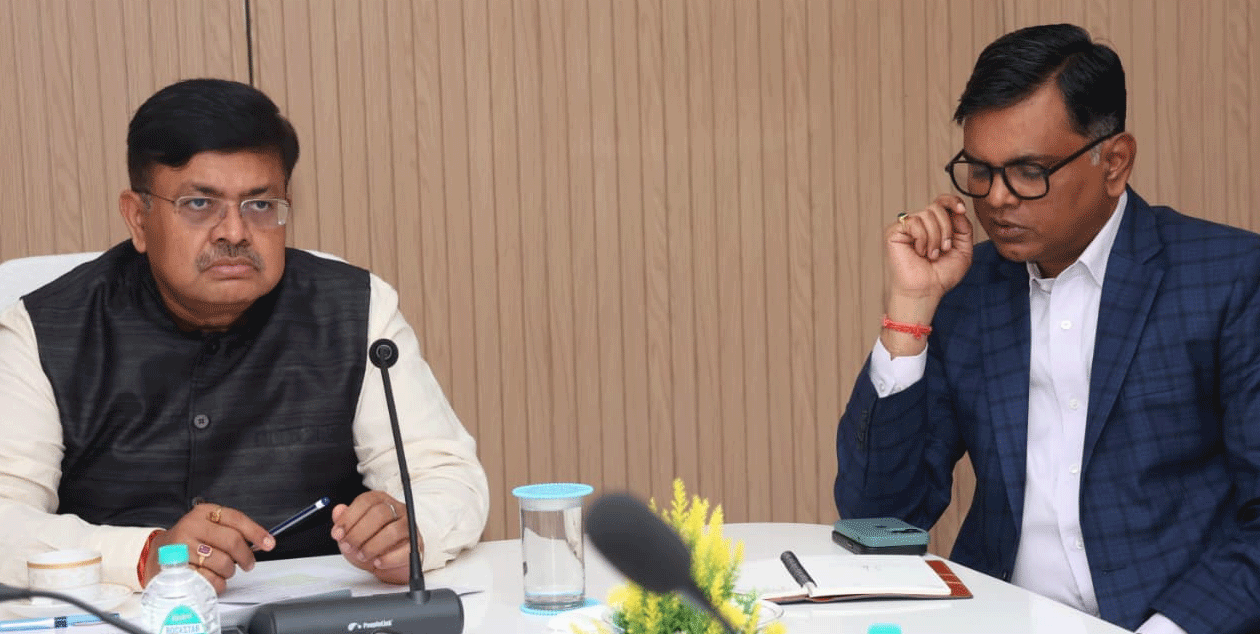
During a high level review meeting held at Lok Seba Bhawan Shri Prithiviraj Harichandan finalized the roadmap for a series of interconnected road projects designed to redirect traffic away from the city core and provide seamless connectivity to the burgeoning peripheral zones.
Principal Secretary of Works, Shri Sanjay Kumar Singh outlined the issues pertaining to Capital City Mobility Program and presented details for the deliberations. At the heart of the Bhubaneswar Decongestion Plan is a multi pronged strategy that balances the expansion of existing arterial routes with the creation of entirely new greenfield corridors.
The Jaydev Vihar to Nandankanan stretch, arguably the most congested artery in the city, is slated for a major transformation. This includes the development of parallel roads on both the left and right sides to absorb local traffic, alongside a proposed elevated corridor that aims to make the main thoroughfare virtually signal free. Recent eviction drives in areas like Salia Sahi underscore the government’s intent to clear long standing bottlenecks for these parallel paths, which serve as the lifeblood for the city’s northern expansion toward the IT and educational hubs.
The geographical scope of the plan extends far beyond the central business district. A significant portion of the review focused on enhancing accessibility to premier health and education institutions. The AIIMS road and its accompanying front road are being prioritized to ensure that emergency medical transit remains unaffected by urban gridlock. Similarly, the project list includes the expansion of the road from Kalinga Studio to SUM Hospital, acknowledging the rapid residential densification in the city’s western flank.
Strategic bypasses form the outer shell of this decongestion effort. The Inner Ring Road and the massive 111 kilometer Capital Region Ring Road, or Outer Ring Road, are intended to divert heavy commercial vehicles and long distance travelers who currently have no choice but to pass through the city center. By connecting Rameshwar to Tangi via a six lane access controlled highway, the plan effectively creates a buffer that isolates intra city traffic from the national highway transit. This is complemented by specialized links like the Daya West canal road and the Gohira to Gothapatana via Madanpur road, which are designed to open up new land parcels for planned urban growth, preventing the haphazard sprawl that often follows unplanned connectivity.
Analysis of the proposed interventions suggests a shift toward modern engineering solutions such as underpasses and multi level road systems. The review of underpass projects, particularly at major intersections like AG Square and Press Square, indicates a move away from traditional traffic signaling in favor of continuous flow dynamics. By eliminating the stop and start nature of city driving, the government expects a significant reduction in vehicular emissions and travel time, which is currently estimated to have increased by nearly thirty percent during peak hours over the last five years.
The technical execution of these projects is now on a fast track. Principal Secretary of Works, Shri Sanjay Kumar Singh, alongside a cohort of chief engineers, has mandated the completion of Detailed Project Reports (DPRs) within a strict timeframe. This administrative urgency reflects a realization that infrastructure must precede population growth rather than react to it. The involvement of the Odisha Bridge and Construction Corporation (OBCC) and various specialized engineering wings ensures that the projects will incorporate modern drainage and utility ducting, preventing the frequent road cutting that often plagues urban infrastructure.
As the city transitions into a Tier 1 metropolitan entity, these projects represent more than just asphalt and concrete; they are a socio economic necessity. Enhanced connectivity to areas like Chhatabar, Gothapatana, and Kaimatia will likely trigger a real estate boom in the outskirts, potentially lowering the population density of the old city and creating a more distributed, polycentric urban model. The successful implementation of the Bhubaneswar Decongestion Plan will ultimately depend on the synchronicity between land acquisition, timely funding, and the engineering precision of the underpasses and flyovers that are set to redefine the city’s horizon.