

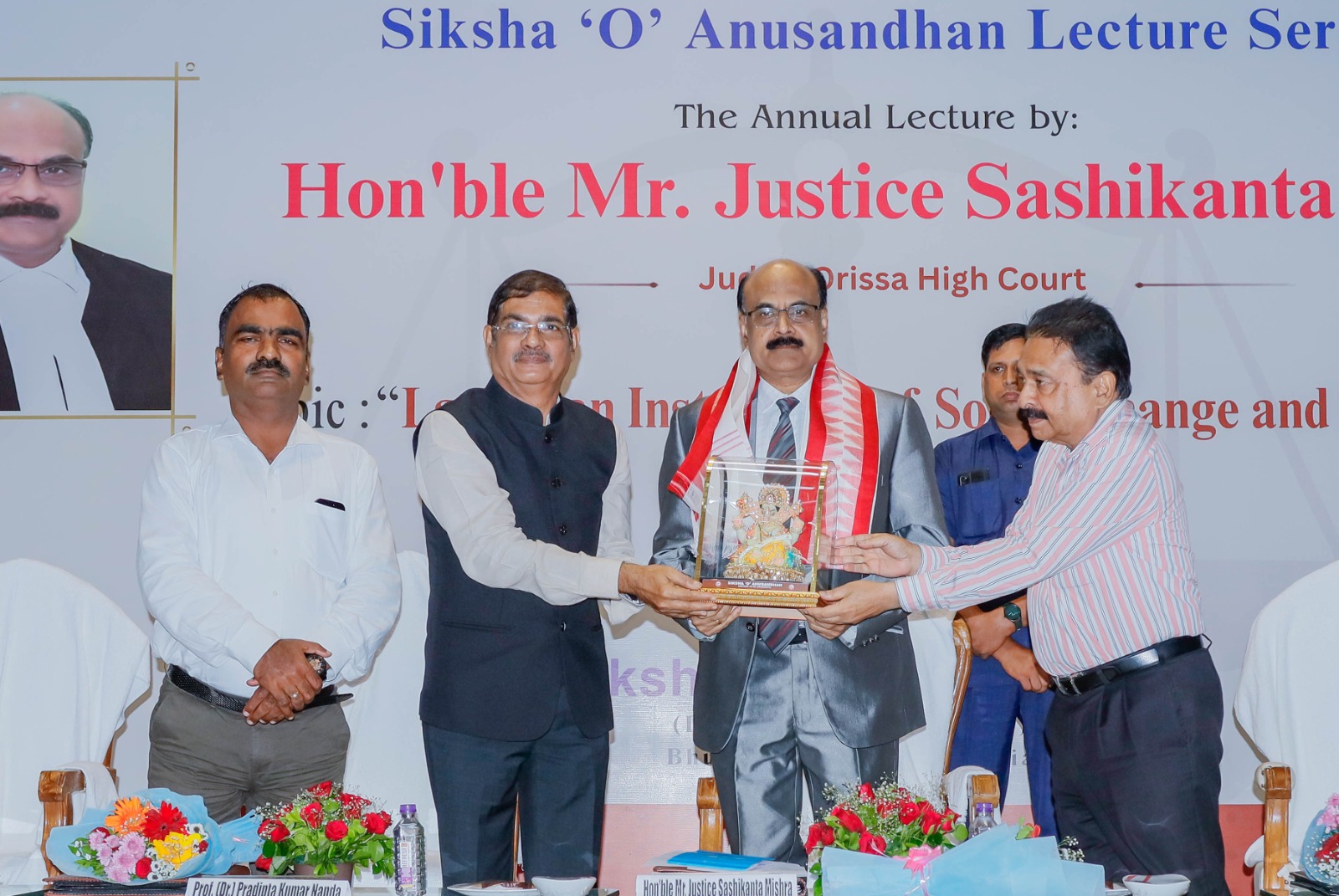
Bhubaneswar: The evolution of the legal system over the years in India has ushered in social changes triggering transformation in different fields, Mr. Justice Sashikanta Mishra, Judge of the High Court of Orissa, Cuttack, said on Saturday.
“The law operates as an engine of change. When the law acts, the society follows”, Mr. Justice Mishra said while delivering a lecture on the subject ‘Law as an Instrument of Social Change and Good Governance’ at the SOA Deemed to be University here.
The event, which was part of the SOA lecture series, was attended by SOA’s students of legal studies and agriculture and faculty members and presided over by the university’s Vice-Chancellor Prof. Pradipta Kumar Nanda. Prof. S.A.K. Azad, Dean of SOA National Institute of Law (SNIL) introduced the speaker. Prof. Jyoti Ranjan Das, Dean (Students’ Welfare) proposed the vote of thanks.
Mr. Justice Mishra said during the pre-constitution era, the society lay fractured with the evil of untouchability dividing the people. Those dubbed as untouchables were debarred from entering any temple and there was no clarity as to how to deal with such a situation, he said.
Article 17 of the Indian constitution removed this barrier making every citizen equal. It ensured that no one could treat another person as an untouchable, he said adding judicial intervention in different areas over the years has brought in revolutionary changes in the society.
Referring to legal interventions which made it mandatory to sport a helmet while riding a two-wheeler or wearing the seat belt while driving a car, Mr. Justice Mishra said earlier cars did not have any provision of seat belt but today if the driver did not wear one he was liable to be punished. In fact, presently every car manufacturer has to make provision of seat belt in the vehicle, he said.
The ban imposed by the court on smoking in public places in India was a revolutionary step, he said adding “we rarely find anyone smoking in a public place these days while separate provision is made for smokers in such places.”
Listing the transformations brought in through the law, Mr. Justice Mishra referred to the RTI Act, recognition of the third gender and reservation which was meant to bring groups of underprivileged people into the mainstream of the nation.
Pointing out that the evil of dowry emanated from a chauvinistic mindset where the groom’s relatives thought that they were doing a favour to the bride’s family by accepting her into their home and therefore needed to be compensated, he said that the law was serious and severe about it.
“We must thank the law for abolishing a cruel act like ‘sati’ while a progressive idea like widow remarriage had been made legal and an evil like child marriage removed through the law,” Justice Mishra said while describing Article 21 of the constitution which empowered each citizen with the ‘right to life’ as the ‘soul of the constitution.’
He also referred to the landmark Supreme Court of India judgment of 1997, also known as the ‘Visakha case’, which defined sexual harassment at the workplace establishing legally binding preventive guidelines for the safety of women.
Governance, he said, was about steps to ensure adherence to the law, ensure accountability and transparency and enable the peoples’ participation in the democratic process. Strong anti-corruption measures were also needed for which the Prevention of Corruption Act was enacted, he said.
Stating that most matters which were placed before him as a judge of the High Court pertained to pleas that action be initiated to address a problem, Mr. Justice Mishra said it was the judiciary which ensured good governance.
Addressing the agriculture students, Mr. Justice Mishra said they should start thinking like a farmer as around 70 per cent of the country’s population depended on agriculture for a living.
“You should know how the law operates and should have an open mind,” he said adding “the human mind is like a parachute which works when it is open.”