

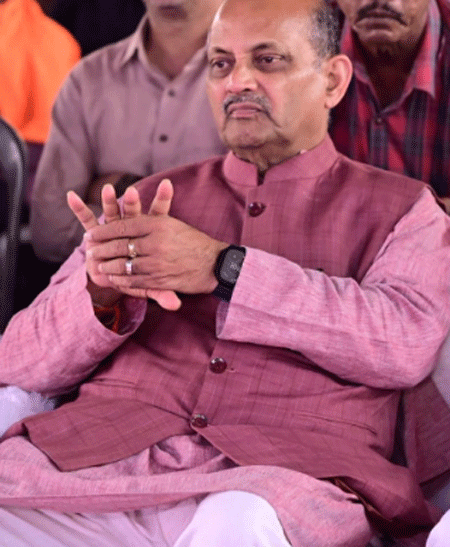
Bhubaneswar: Mounting impatience and internal friction mark the ongoing delay in appointing leaders to Odisha’s state-run corporations, boards, and public sector undertakings, despite repeated public assurances from Odisha BJP President Shri Man Mohan Samal.
Over two years after the BJP government took charge under Chief Minister Shri Mohan Charan Majhi in June 2024, nearly 150 political positions across approximately 37 state bodies remain vacant, leaving grassroots cadres and aspiring party leaders waiting for political rehabilitation.
State Party Chief Shri Man Mohan Samal has publicly addressed the pending appointments on at least five separate occasions, each time signaling that the selection process was in its final stages.
In July 2025, following his unopposed re-election as the Odisha BJP President, Shri Samal indicated that shortlisting was underway for appointments to various state boards and corporations, aligning with prospective government restructuring.
By December 2025, Shri Samal told reporters that nominations for boards, corporations, and government legal posts had reached the final phase, projecting that official announcements would be rolled out by early January.
In April 2026, he reiterated that all pending postings would be finalized before the government completed its second year in office.
In May 2026, during high-level organizational discussions chaired by party leadership in Bhubaneswar, Shri Samal again fielded queries regarding corporation heads, asserting that decisions would be taken at an appropriate time following consultations with central party leaders.
Most recently, in August 2026, Shri Samal provided similar reassurances to accommodate dedicated party workers without further delay and process is on.
Despite these recurrent timelines, zero official notifications have materialized for the majority of these positions, giving rise to growing resentment within party ranks.
Political observers point out that the political bottleneck stems from complex administrative and organizational mechanics. Unlike routine government postings, political appointments to state corporations require explicit clearances from central party leadership in New Delhi.
Furthermore, party managers face the delicate task of balancing competing interests among veteran party leaders, grassroots workers, former legislators, and recent entrants from other political parties.
Coordination between the party organization and the Chief Minister’s Office has also added layers to the vetting process to ensure candidates match operational requirements.
While Shri Samal’s frequent statements serve to keep cadre morale intact, the persistent gap between assurances and implementation continues to draw criticism from both opposition parties and within the ruling party’s own aspiring ranks.