

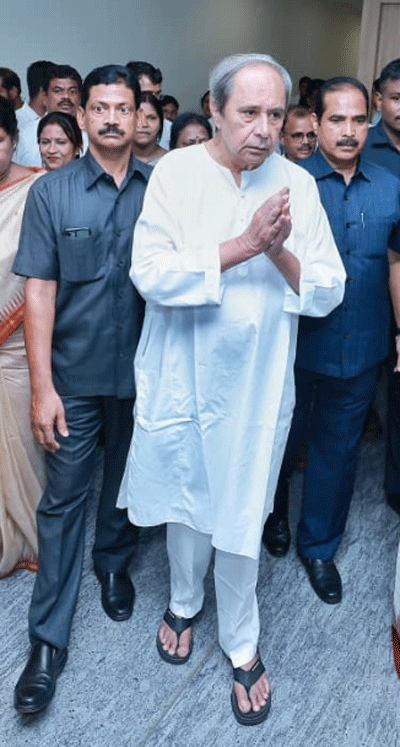
Bhubaneswar: Many political observers believe that BJD President Shri Naveen Patnaik has not learnt his lesson after biting the dust twice, once in the 2024 general election and again in the Nuapada by-poll, where the Biju Janata Dal experienced a humiliating defeat by slipping to third place.
This sequence of electoral setbacks suggests that the party leadership is continually taking false steps, a critique that has gained renewed momentum following the induction of former bureaucrat Sujata Rout Karthikeyan into the party. Her entry has triggered visible friction, particularly among the party’s younger leaders and ground cadres who view this as a failure to course-correct after consecutive defeats.
To analyze why youth groups within the party are so peeved by this political entry, it is helpful to look at how it impacts their individual career trajectories. There is a strong sense of a bottlenecked career path for youth workers. For years, young party functionaries, student leaders, and grassroots workers have dedicated their careers to building the party machinery, expecting that active field politics would lead to leadership elevation.
When lateral entrants from the bureaucracy are brought in and immediately positioned for prominent or strategic roles, it creates a sense that organizational loyalty and grassroots labor are secondary to administrative backgrounds.
This core sentiment is exactly what drives the deep internal rift, as seasoned political workers strongly believe that managing a department is fundamentally different from navigating the unpredictable landscape of public politics. Politics requires an organic, emotional connection with the electorate and a willingness to rise through the ranks, qualities that cannot be replicated by administrative decree or technocratic planning.
When a party relies heavily on former bureaucrats to fill its leadership vacuum, it risks converting a political movement into a corporate entity, which rarely resonates with the masses. Bureaucratic training is rooted in systemic control, rule-following, and top-down management, whereas successful political leadership demands negotiation, mass mobilization, and constant accountability to the grassroots. For the young cadres who understand the pulse of the street, watching individuals transition straight from the comfort of administrative offices into strategic political roles feels like a direct insult to the art of actual field politics.
By treating party management as an extension of administrative governance, the leadership overlooks the basic reality that winning back the trust of the electorate requires battle-hardened politicians, not retired officers. This perspective reinforces the youth group’s argument that the party is failing to see that grassroots politics is simply not a bureaucrat’s cup of tea.
Furthermore, the shadow of these recent electoral defeats looms heavily over this decision. Sujata Karthikeyan is the wife of V.K. Pandian, the bureaucrat-turned-politician whose massive influence within the party and government was widely blamed by internal factions for the party losing power in Odisha. While Pandian officially withdrew from active politics after the initial electoral setback, younger cadres view Sujata’s entry as a continuation of the same bureaucratic dominance that alienated traditional party workers in the first place. For the youth who bore the brunt of the party’s defeat on the ground in both the general elections and the Nuapada by-poll, reviving a similar leadership model feels completely counterproductive to the party’s rebuilding process.
Finally, the entry raises serious concerns regarding the succession strategy and internal democracy. Many young leaders had hoped that the post-election phase would force the party to restructure organically, opening doors for home-grown, young political faces to define the future of the party. By opting for a high-profile ex-bureaucrat, the leadership signals a preference for technocratic control over purely political leadership. This blocks the natural evolution of secondary and tertiary tiers of leadership, frustrating ambitious young politicians who want a say in policy and party direction.
Recognizing this internal pushback, Naveen Patnaik explicitly stated that Sujata would serve as a ‘simple’ primary member without an immediate official post, and reaffirmed that he would continue to lead the party himself. However, for the youth cadres, her entry represents a structural continuity that they believe ignores the core lessons of their recent humiliating losses and signals that the leadership remains stuck in its old, top-down patterns of management.