

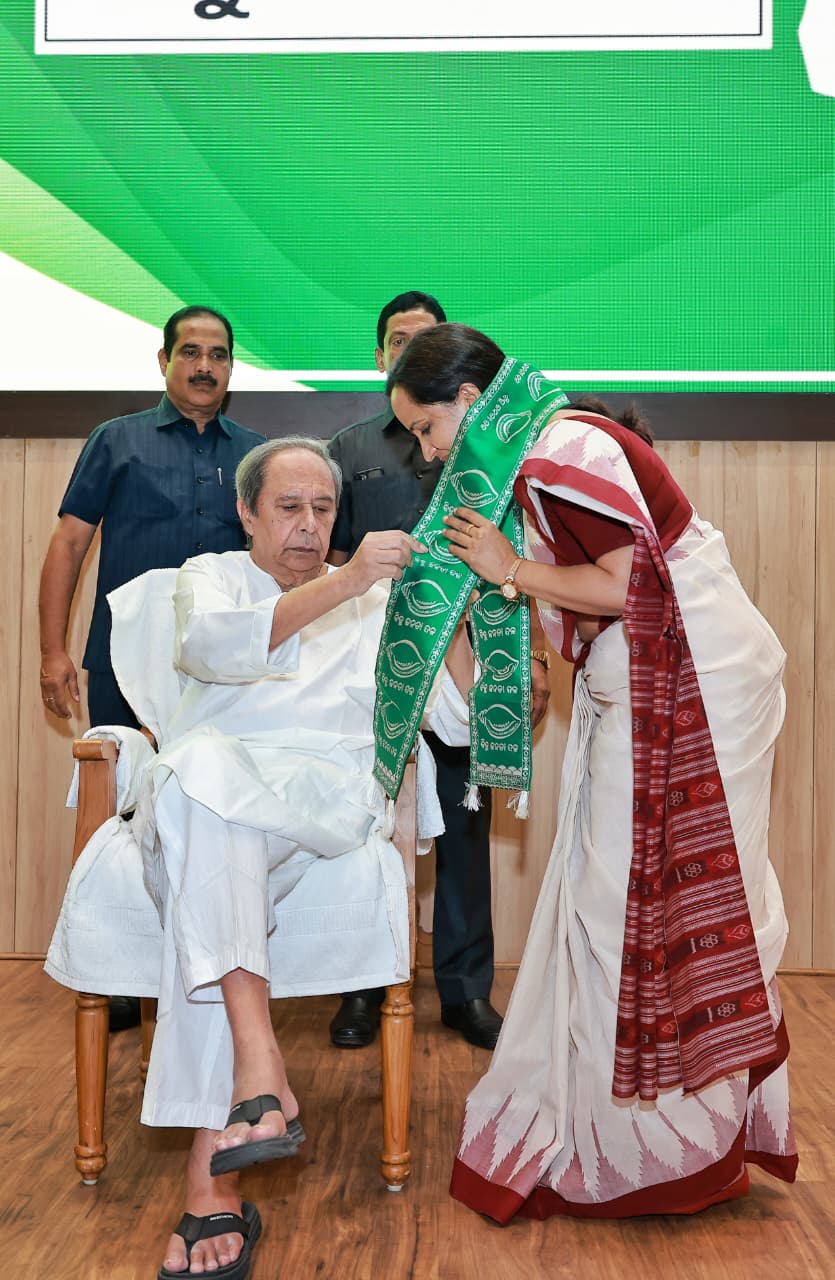
Bhubaneswar: The formal induction of former IAS officer Sujata R. Karthikeyan into the Biju Janata Dal marks a watershed moment in Odisha’s contemporary political landscape. For a party transitioning into the unfamiliar territory of the opposition after nearly a quarter-century in power, this decision represents a calculated, high-stakes gamble. The move attempts to balance structural rejuvenation against the heavy baggage of recent electoral defeat, and its outcome will likely dictate the party’s trajectory over the next political cycle.
To understand the deeper strategic implications, one must analyze the structural core of the BJD’s historical hegemony. The party’s dominance was built on a dual foundation: the unassailable personal charisma of Naveen Patnaik and a massive, institutionalized network of rural women mobilized under the Mission Shakti initiative. As the former secretary of Mission Shakti, Shrimati Karthikeyan was not merely a bureaucrat; she was the architect of a socio-economic apparatus that converted state-backed financial empowerment into a loyal, resilient voting bloc.
By formally bringing her into the political fold, the BJD leadership is signaling an urgent desire to reclaim this core constituency, which showed signs of fracturing during the 2024 assembly and parliamentary elections. In the opposition, the party no longer commands the state machinery to distribute patronage or launch new welfare schemes. Shrimati Karthikeyan’s institutional knowledge of the self-help group network becomes a critical asset, allowing the party to maintain a direct, personalized line of communication with millions of women voters outside the formal apparatus of state government.
Furthermore, her entry addresses a profound organizational deficit. The transition from a ruling establishment to an opposition front requires a radical shift in human resource management. Opposition politics demands rigorous policy critique, relentless media monitoring, and the coordination of state-wide agitations—skills that differ vastly from managing a incumbency-driven election. With several veteran leaders adopting a cautious, passive stance post-defeat, the party lacks a central nervous system capable of synthesizing policy data into potent political narratives. Shrimati Karthikeyan’s administrative acumen provides the BJD with a sophisticated internal coordinator who can dissect government policies and arm the party cadre with substantive, data-driven counterarguments against the Governing Bharatiya Janata Party.
However, political analysis cannot overlook the severe counter-pressures this induction generates. The foremost risk is structural irony: the very attribute that makes her valuable—her bureaucratic pedigree—is precisely what catalyzed the BJD’s electoral downfall. The central narrative of the BJP’s successful 2024 campaign was the alleged subversion of Odia pride and democratic norms by a non-Odia bureaucratic clique, symbolized primarily by her husband, Shri V.K. Pandian.
By inducting Shrimati Karthikeyan, the BJD risks validating the opposition’s most damaging critique. It hands the BJP a ready-made rhetorical weapon to argue that the BJD has failed to internalize the lessons of its defeat and remains structurally dependent on the same bureaucratic nucleus. This move could dilute the BJD’s attempts to rebrand itself as a grassroots, worker-centric party, making it easier for rivals to paint the leadership as insulated and tone-deaf to public sentiment.
This perception problem is inextricably linked to internal party cohesion. The BJD is currently a tinderbox of generational and ideological friction. For years, traditional politicians within the party chafed under what they perceived as an over-centralization of power in the hands of unelected officials. The post-2024 period saw a quiet resurgence of these regional satraps who argued for a return to pure, grassroots politics.
Shrimati Karthikeyan’s entry threatens this fragile equilibrium. Senior leaders and regional power brokers may view her appointment as a continuation of the old guard’s preference for managerial control over traditional political networking. If her role is perceived as an attempt to manage the party from the top down, it could deepen existing fault lines, leading to passive non-cooperation from the cadre or, worse, a secondary wave of high-profile defections to the BJP.
Ultimately, the political utility of Sujata R. Karthikeyan will depend entirely on tactical execution and role definition. If she is positioned as an aggressive public face or pushed into immediate electoral contention, the move will likely backfire, triggering intense media scrutiny and uniting internal detractors. Conversely, her true value lies in acting as an invisible organizational engine—a backroom strategist who quietly restructures the party’s auxiliary wings, mends broken communication channels with rural women, and modernizes the party’s research and communication cells. By operating away from the glare of public controversy, she can deliver the administrative efficiency the BJD desperately needs without triggering the anti-bureaucratic allergies that cost the party its mandate.