

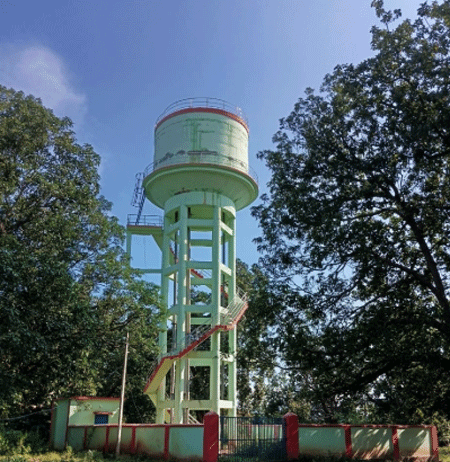
Bhubaneswar: Odisha Cabinet has officially approved the Operation and Maintenance Policy for Rural Drinking Water Supply 2026, marking a strategic shift from infrastructure creation to long-term service sustainability. Chief Secretary, Shrimati Anu Garg briefed Media after the Meeting.
This landmark policy aims to ensure that every rural household receives safe and reliable drinking water daily by establishing a comprehensive framework for asset management and financial accountability.
Under the new policy, the state is introducing decentralized governance by clearly defining the roles of the Rural Water Supply and Sanitation department, district authorities, Gram Panchayats, and Village Water and Sanitation Committees. To maintain these systems, the government will implement structured user charge mechanisms and dedicated village-level maintenance funds. The policy also prioritizes modern oversight through digital monitoring systems, including SCADA, IoT-based technology, and a centralized Command and Control Centre for real-time data.
The initiative comes as Odisha reports significant growth in its water infrastructure. During the tenure of the current government, the number of villages receiving water through functional household tap connections has risen from 6,032 to more than 21,000. Recent accomplishments include the completion of 27 mega piped water projects, 3,046 single-village schemes, and 2,702 solar-based systems. Additionally, 28,741 tubewells have been installed to serve as supplemental water sources.
To ensure quality and timely delivery, the state has maintained strict oversight on executing agencies. Penalties totaling nearly 1,120 crore rupees have been imposed for unsatisfactory progress, and FIRs have been filed where necessary. Officials emphasized that the new policy is designed to be implemented within existing financial provisions, ensuring no additional permanent financial liability for the state while safeguarding the substantial public investment already made in rural water systems.