

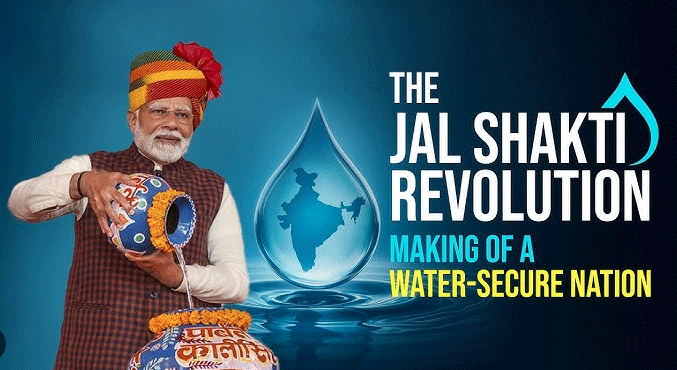
New Delhi: Prime Minister Narendra Modi has successfully transitioned water conservation from a mere government policy into a massive public movement, known as a Jan Andolan, aimed at securing India’s future. Drawing from his personal experiences in drought-prone Gujarat, the Prime Minister has prioritized water security as a foundational element of national development.
During his tenure as Chief Minister of Gujarat, he initiated transformative projects like the Sujalam Sufalam Yojana and the expansion of the Narmada canal network. These efforts brought water to parched regions such as Kutch and Saurashtra, significantly raising groundwater levels and revitalizing agriculture. He also introduced the Wasmo model, which empowered village-level water committees, particularly those led by women, to manage their own water resources.
As Prime Minister, he scaled these successful models to a national level. The launch of the Jal Shakti Ministry in 2019 consolidated water-related efforts, leading to the ambitious Jal Jeevan Mission. This mission has provided tap water connections to over 15 crore rural households, drastically reducing the physical burden on women and improving public health. Other key initiatives include the Namami Gange mission for river rejuvenation and the Amrit Sarovar project, which saw the creation of 75 water bodies in every district to mark 75 years of independence.
The Prime Minister’s approach emphasizes sustainable practices such as micro-irrigation, rainwater harvesting, and the catch the rain campaign. By integrating traditional wisdom with modern technology, the government aims to ensure per drop more crop and long-term water sustainability. The movement continues to grow, driven by the belief that water conservation is a shared national duty essential for achieving a self-reliant and prosperous India.
Prime Minister Narendra Modi has successfully transitioned water conservation from a mere government policy into a massive public movement, known as a Jan Andolan, aimed at securing India’s future. Drawing from his personal experiences in drought-prone Gujarat, the Prime Minister has prioritized water security as a foundational element of national development.
Shri Ashok Kumar Meena, Secretary of the Department of Drinking Water and Sanitation (DDWS), has emphasized that this transformation relies heavily on a community-centered approach and the integration of modern technology.
Shri Meena has highlighted the critical role of digital public infrastructure, such as SCADA and IoT systems, in improving water quality monitoring and ensuring efficient service delivery across rural India.