

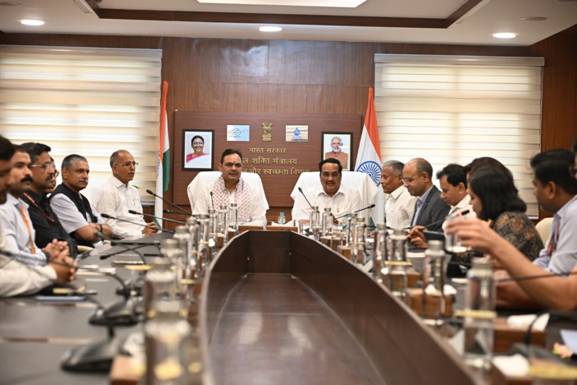
New Delhi: In a landmark step towards strengthening rural drinking water governance, Memorandum of Understanding (MoUs) under Jal Jeevan Mission (JJM) 2.0 were signed with the States of Rajasthan and Madhya Pradesh, marking the formal launch of reform-linked implementation under the extended phase of the Mission which was approved by the union cabinet on 10th March 2026.
The MoU with the State of Rajasthan was signed in forenoon, in the presence of Union Minister of Jal Shakti, Shri C. R. Paatil, Chief Minister of Rajasthan, Shri Bhajan Lal Sharma, and Minister of State, Ministry of Jal Shakti, Shri V. Somanna. The ceremony was also attended by Shri Kanhaiya Lal Choudhary, Minister, PHED, Rajasthan, along with senior officials from the Centre and the State Government.
The MoU with the State of Madhya Pradesh was signed at 3.00 pm in the presence of Union Minister of Jal Shakti, Shri C. R. Paatil, Chief Minister of Madhya Pradesh, Dr. Mohan Yadav, who joined the event through video conferencing. Shri V. Somanna, Minister of State, Ministry of Jal Shakti, and Smt. Sampatiya Uikey, Minister, PHED, Madhya Pradesh, along with senior officials from the State Government, was also present during the signing of MoU.
Senior officials from the Department of Drinking Water and Sanitation (DDWS), including Shri Ashok K. K. Meena, Secretary, DDWS, Shri Kamal Kishore Soan, Additional Secretary & Mission Director, NJJM along with senior officials from DDWS and PHED Rajasthan and Jal Nigam, Madhya Pradesh were present during the MoU signing.
For Rajasthan the MoUs was signed and exchanged between Smt. Swati Meena Naik, Joint Secretary (Water), DDWS, and Shri Akhil Arora, Additional Chief Secretary, PHED Rajasthan.
For Madhya Pradesh it was signed and exchanged between Smt. Swati Meena Naik, Joint Secretary (Water), DDWS, and Shri P. Narahari, Principal Secretary, PHED Madhya Pradesh.
Addressing the gathering, Union Minister of Jal Shakti, Shri C. R.Paatil, referring to recent Parliamentary deliberations, reiterated that the Union Government follows a zero-tolerance policy towards corruption and emphasized that quality, transparency and accountability must guide all works undertaken under Jal Jeevan Mission and urged both States to ensure strict adherence to quality standards so that assets created remain functional and sustainable over the long term.
Highlighting the diverse water management challenges across States, including Rajasthan’s water scarcity and the varied hydro-geological conditions of Madhya Pradesh, in his address Shri Paatil appreciated both States for their proactive leadership in signing the reform-linked MoUs and said that this reflects the importance of drinking water for the people and the strong commitment of State Governments towards ensuring water security.
While Addressing, Union Minister of Jal Shakti, Shri C. R. Paatil, emphasised the importance of timely and quality execution, stating that effective implementation under the Jal Jeevan Mission would significantly reduce the drudgery of women and girls, particularly in water‑stressed and rural regions such as Rajasthan and Madhya Pradesh, while ensuring reliable and safe drinking water services for all.
Chief Minister of Rajasthan, Shri Bhajan Lal Sharma, stated the State’s commitment for effective implementation of Jal Jeevan Mission and assured that Rajasthan would uphold the confidence placed in it through timely execution and strict adherence to the structural reforms envisaged under JJM 2.0, with a focus on quality works, institutional strengthening and long‑term sustainability of rural drinking water systems in alignment with the national reform framework.
Chief Minister of Madhya Pradesh, Dr. Mohan Yadav, affirmed the State Government’s commitment to aligning with the national reform agenda under Jal Jeevan Mission 2.0 and ensuring effective implementation of the structural reforms and also stated that Madhya Pradesh would adhere to the conditions outlined in the reform‑linked MoU, prioritising strengthened governance systems, improved service delivery mechanisms, achieving the aspiration of 24×7 drinking water supply, and ensuring the long‑term sustainability of rural drinking water supply schemes.
The MoU covers implementation of 11 key structural reform areas, aimed at strengthening governance, institutional capacity and long‑term sustainability of rural drinking water systems, including: