

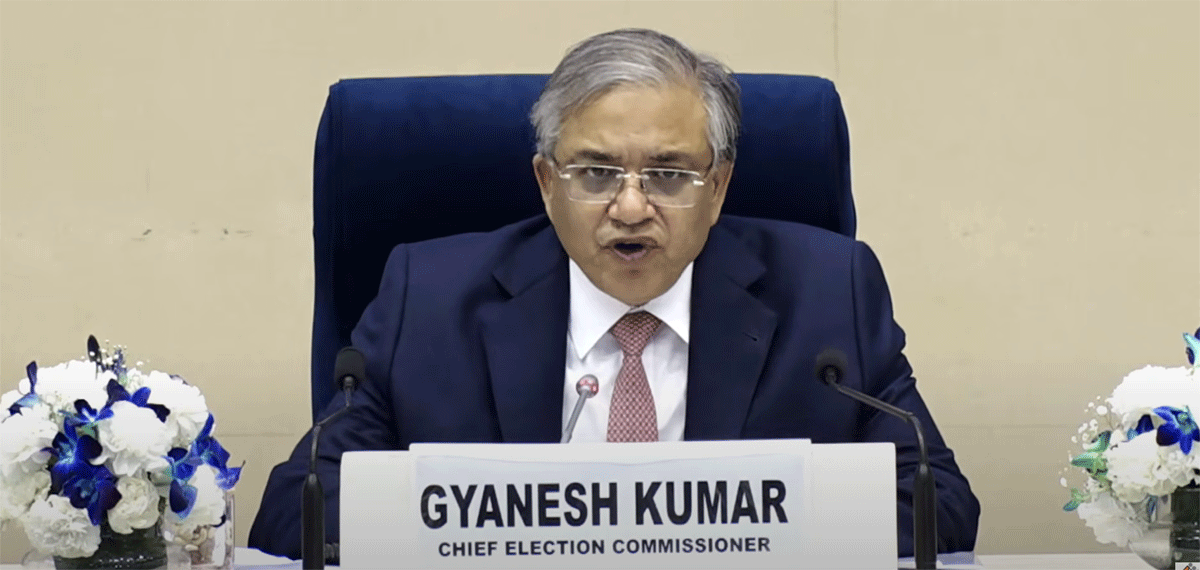
New Delhi: The Election Commission of India has officially announced the schedule for the 2026 General Elections to the Legislative Assemblies of Assam, Kerala, Tamil Nadu, West Bengal, and the Union Territory of Puducherry. Following a series of state visits and reviews of law and order and poll preparedness, the Commission has set the stage for a significant electoral exercise involving five regions.
Chief Election Commissioner, Shri Gyanesh Kumar and Team ECI presented details in a Media Meet held here on 15 March. This announcement triggers the immediate implementation of the Model Code of Conduct across these states and the Union Territory, affecting candidates, political parties, and the respective governments.
According to the established schedule, elections for all 126 Assembly Constituencies in Assam and all 140 Assembly Constituencies in Kerala will be held in a single phase on April 9, 2026. For these regions, the official gazette notification will be issued on March 16, 2026, with the deadline for filing nominations set for March 23, 2026. After the completion of the nomination scrutiny and withdrawal periods, the counting of votes for these states is scheduled for May 4, 2026.
The upcoming elections will cater to a vast electorate, with West Bengal having the largest number of total electors at over 6.45 crore. Tamil Nadu follows with approximately 5.67 crore electors, while Kerala and Assam have roughly 2.71 crore and 2.50 crore electors, respectively. Puducherry has a total of approximately 9.44 lakh electors. To manage this scale, the Commission has increased the number of polling stations, establishing over 80,000 in West Bengal and 75,000 in Tamil Nadu.
Several measures have been introduced to ensure an inclusive and accessible voting process, including an optional postal ballot facility for absentee voters such as senior citizens aged 85 and above and persons with disabilities. Dedicated polling teams will visit the homes of those who opt for this facility to collect their votes while maintaining secrecy. Additionally, the Commission has directed that at least one polling station in every constituency be managed exclusively by women and another by persons with disabilities. All polling stations are also required to be equipped with Assured Minimum Facilities, including drinking water, ramps, and adequate lighting.
To enhance transparency, Voter Verifiable Paper Audit Trail machines will be deployed alongside Electronic Voting Machines at every polling station. The Commission has also introduced color photographs of candidates on the ballot units to assist voters in easy identification. Furthermore, candidates have the option to facilitate their nomination process online through the Suvidha portal, although physical submission of notarized affidavits to the Returning Officer remains a requirement. Political parties are also mandated to publish detailed information regarding candidates with criminal backgrounds on their websites and in local media.