

Bhubaneswar: Industry leaders and global investors have expressed high levels of satisfaction with the rapid pace of regulatory changes in Odisha, noting a transformative shift in the state’s operational climate.
Appreciation is also flowing from Top Administrators of the Union Government, including Cabinet Secretary, Union Secretary DPIIT and Union Secretary Labour and Employment, for Odisha’s Business Reform Action Plan(BRAP) implementation efforts, said sources.
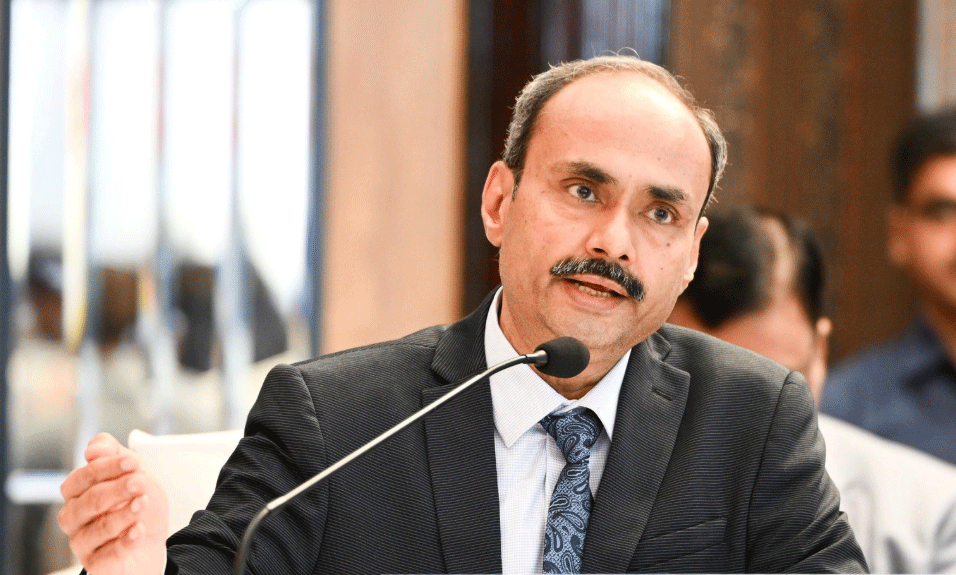
This newfound ease of operations is being largely attributed to the strategic oversight of Shri Hemant Sharma, who, in his capacity as Additional Chief Secretary for Home, Industries, and Information and Public Relations, as well as Chairman IPICOL has effectively bridged the gap between policy formulation and ground-level execution.
Captains of industry attending recent investor summits in 2026 have highlighted that the state’s administrative machinery now functions with a level of predictability and speed previously unseen in the region. The systematic removal of traditional bottlenecks—ranging from land allotment delays to complex labor compliance—has converted Odisha into a high-trust environment for capital.
ACS Shri Hemant Sharma’s leadership has been particularly noted for the successful “grounding” of investments. By ensuring that Memorandums of Understanding (MoUs) transition rapidly into operational units, the administration has secured commitments exceeding 1 lakh crore in the first quarter of 2026 alone.
Major players in metal downstream, green energy, and chemicals sectors have specifically credited the seamless digital interface of the GOSWIFT portal and the proactive grievance redressal mechanism for their expanded footprint in the state.
The current Business Reform Action Plan 2026, guided by ACS Shri Sharma, emphasizes nine core areas of process re-engineering. This includes the full automation of renewal processes for licenses and the integration of third-party inspections. These reforms have significantly reduced the cost of doing business, making Odisha a more competitive alternative to traditional industrial hubs.
Furthermore, industrialist satisfaction is bolstered by the synchronization of the Home and Industry departments under a single administrative lead. This convergence has allowed for a unified approach to industrial security and law and order, ensuring that manufacturing zones remain stable and productive.
The integration of 154 reform points under the District Business Reform Action Plan has further localized these benefits, ensuring that small and medium enterprises in every district feel the same level of administrative support as mega-projects.
As the state moves toward its goal of contributing 5% to the national GDP by 2047, the consensus among industry stalwarts is that the current reform trajectory has made Odisha a benchmark for ease of doing business in India.