

Bhubaneswar: Meteorological assessments for the state of Odisha indicate a steady transition as the winter season begins to recede. Over the next seven days, dry weather is expected to prevail across all districts. While the interior regions and hill stations continue to experience a lingering chill, a gradual warming trend is emerging.
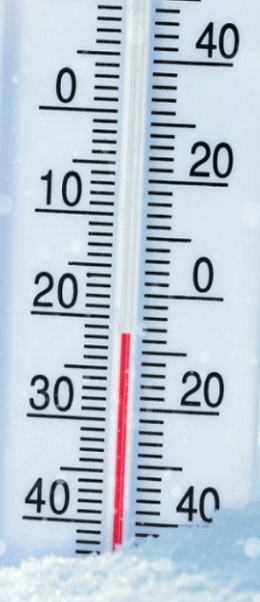
Minimum temperatures are projected to rise by 2 to 3 degrees Celsius over the coming days, signaling an end to the intense cold wave conditions recently observed in districts like Kandhamal.
Coastal regions, including the twin cities of Bhubaneswar and Cuttack, will likely see early morning mist or shallow fog, followed by clear and sunny skies for the remainder of the day. In the northern and western interior parts of the state, such as Jharsuguda and Rourkela, daytime temperatures are already climbing, with some areas touching the 34 to 35 degree Celsius mark.
This contrast between the cool nights and increasingly warm afternoons will characterize the weather pattern for the third week of February 2026.
Looking back twenty-five years to the year 2000, the climatic landscape of Odisha during February presented a different profile. Historical data for February 2000 shows that the state was experiencing a period of significant temperature fluctuation. In the capital city of Bhubaneswar, minimum temperatures often hovered between 15 and 18 degrees Celsius, while maximums typically reached 30 to 32 degrees Celsius.
During that specific year, the region was also recovering from the aftermath of the 1999 Super Cyclone, which had altered local environmental conditions. Agricultural records from the 2000-2001 period indicate that the winter season saw a substantial departure in rainfall, with a nearly 85 percent deficit in post-monsoon and winter precipitation compared to normal averages.
This led to a particularly dry and dusty February, much like the conditions seen today, though the decadal trend suggests that average temperatures in the late 90s and 2000 were generally about 0.5 to 1.0 degree Celsius cooler than the current 2026 averages.
Interior districts such as Phulbani and Angul recorded sharper night chills in 2000, frequently dipping below 10 degrees Celsius with more regularity than is observed in the current warming climate.