

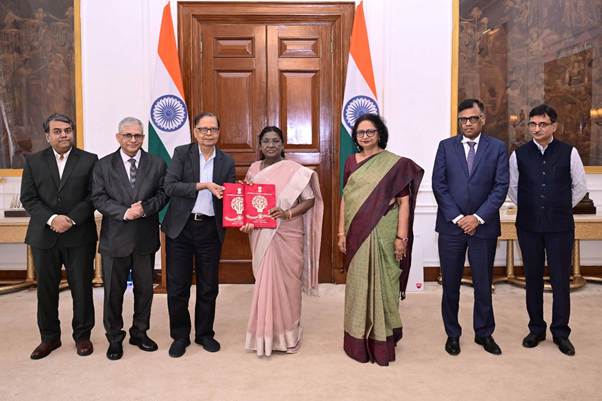
Bhubaneswar: The Sixteenth Finance Commission (SFC) Report presented to President of India indicates that Odisha’s benefits are fundamentally rooted in the commission’s commitment to fiscal equalization and the use of progressive criteria for horizontal devolution. The commission has designed its framework to ensure that states with lower per capita income and specific geographic or demographic challenges receive a higher share of the divisible pool of central taxes.
Odisha benefits significantly from the income distance criterion, which is typically the most heavily weighted factor in the devolution formula. This criterion measures the gap between a state’s per capita income and that of the highest-income state. Since Odisha’s per capita income is lower than the benchmark state, it qualifies for a larger per capita allocation intended to provide the fiscal space necessary to improve its infrastructure and public services. This mechanism ensures that the devolution process remains progressive, focusing resources on states that have a greater need for developmental catch-up.
The commission also accounts for cost disabilities associated with a state’s geography and population density through the area and population criteria. For a state like Odisha, which has a significant geographical area and varying population densities, the area criterion serves as a correction for the higher per capita cost of providing public services in less densely populated or more dispersed regions. By maintaining a weight for the area of the state, the SFC ensures that Odisha is compensated for the additional expenses required to reach citizens in remote or rural locations.
Furthermore, the SFC continues the practice of providing revenue deficit grants to states that face a gap between their assessed revenues and expenditures even after tax devolution. Although the commission emphasizes the need for fiscal discipline, it acknowledges that some states require a “breathing room” to balance their accounts. Odisha, which has historically managed its finances with a degree of prudence, benefits from the commission’s focus on fiscal discipline as a criterion, as this can reward states that maintain stable debt-to-GSDP ratios and controlled revenue deficits.
The commission’s focus on local body grants also provides a direct benefit to Odisha’s grassroots development. By allocating specific grants for rural and urban local bodies, the SFC ensures that funds reach the third tier of government for essential services like water supply, sanitation, and local infrastructure. For a state with a large rural population like Odisha, these untied and tied grants are crucial for improving the quality of life at the village and block levels.
In summary, the Sixteenth Finance Commission benefits Odisha by prioritizing equity over absolute economic contribution. The framework ensures that Odisha’s lower relative income level, its geographical vastness, and its requirements for local governance are all factored into a formula that provides the state with the financial resources necessary to pursue its developmental goals while maintaining fiscal stability.