

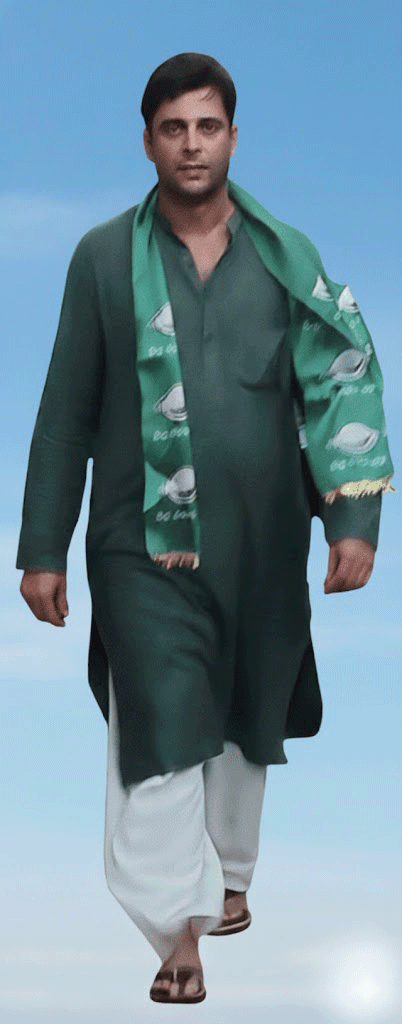
Bhubaneswar: The recent public endorsements of Shri Kalikesh Narayan Singh Deo by senior Biju Janata Dal (BJD) Lawmakers like Captain Dibya Shankar Mishra and Debesh Acharya mark a significant shift in the internal dynamics of the party. While Shri Naveen Patnaik remains the undisputed supremo and the face of the BJD, several factors explain why these leaders are beginning to float the idea of a new provincial leadership.
The primary driver is the search for a sustainable succession plan following the BJD’s loss of power in the 2024 Assembly elections. For over two decades, the party functioned as a monolithic entity centered entirely on Patnaik’s charisma. However, with the party now in the opposition benches and Shri Patnaik nearing 80, there is an increasing realization among the rank and file that the party needs a second line of leadership to remain viable for the long term.
Western Odisha remains a crucial political battleground. By projecting Kalikesh Narayan Singh Deo—who hails from the prominent Bolangir royal family—leaders like Captain Mishra are attempting to consolidate the party’s influence in the western belt. Historically, this region has seen intense competition from the BJP, and proponents of Kalikesh argue that his lineage, education, and experience as a parliamentarian make him a candidate who could be accepted across the state, not just in his home district.
A major catalyst for his rising prominence is his growing national stature. Kalikesh Narayan Singh Deo was recently elected as the President of the National Rifle Association of India (NRAI) in late 2024 and began his full four-year term in December 2025. This prestigious national role has significantly boosted his image beyond Odisha, portraying him as a capable administrator who can navigate the corridors of power in New Delhi. Within the party, this is seen as a vital asset for a leader who may need to negotiate with national entities and represent the state’s interests on a broader stage.
The timing of these statements is also linked to internal friction regarding the influence of non-political advisors and the perceived “outsider” tag that hurt the party in the previous election. By pushing for a “son of the soil” and a seasoned politician like Kalikesh, these lawmakers are subtly signaling a desire for the party to return to its traditional political roots. It is a strategic move to preempt any further vacuum that might lead to further defections or the formation of splinter groups, such as the recently rumored Biju Swabhiman Manch.
However, these calls do not necessarily imply a rebellion against Naveen Patnaik. Instead, they represent a “testing of the waters.” By making these statements publicly, leaders are gauging the reaction of both the party high command and the public. They are positioning Kalikesh as a potential working president or a state-level leader who can handle the day-to-day organizational rigors that Shri Patnaik may eventually step back from.
The political cry one is hearing is the sound of a party in transition, trying to evolve from a personality-driven movement into a more structured regional institution that can survive beyond its founder’s tenure.