

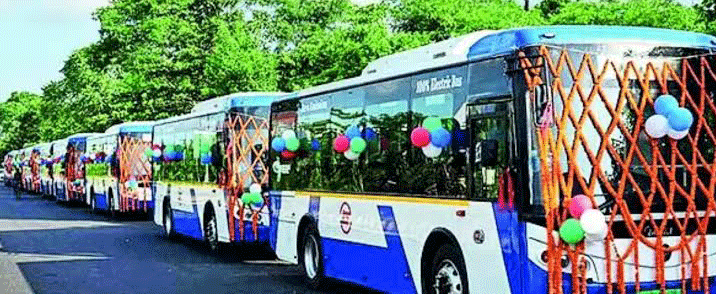
Bhubaneswar: In the rapidly expanding urban corridor of Bhubaneswar and Cuttack, the state-run public transit system—rebranded as Ama Bus—is increasingly being characterized by citizens as a “Killer on Wheels.” While the Capital Region Urban Transport (CRUT) celebrates awards for smart mobility, a darker narrative has emerged from the asphalt: a trail of broken lives and systemic failures that the administration appears either unable or unwilling to address beyond reactionary ex-gratia payments.
The statistics for 2025 alone are staggering, with over 25 major accidents in the Twin City resulting in at least 10 fatalities and dozens of critical injuries. The socio-legal precision of these incidents suggests a crisis far deeper than simple driver error. Analysis of recent tragedies, such as the fatal collision at Rupali Square on January 3, 2026, reveals a pattern of high-speed impacts and a complete disregard for the safety of vulnerable road users like auto-rickshaws and two-wheelers.
Systemic synthesis of the causes uncovers a trifecta of institutional neglect. First, the privatization of the workforce has led to a “gig economy” mentality where drivers, often overworked and under-vetted, are incentivized by strict trip completion targets rather than safety benchmarks.
This creates a moral hazard: to stay on schedule amidst the notorious congestion of Twin City, drivers resort to aggressive maneuvering.
Second, the current infrastructure lacks segregated bus lanes, forcing these heavy vehicles into a lethal dance with lighter traffic on narrow arteries.
Third, the administration’s reliance on passive technology—like GPS and CCTV—has failed as a deterrent because there is no real-time intervention mechanism to stop a speeding bus before the crash occurs.
The remedies currently being ignored by the administration require a radical shift in urban governance. Beyond the standard training sessions and speed governors, the following interventions are essential:
Psychometric and Fatigue Monitoring: The administration must move beyond checking driving licenses to implementing mandatory psychometric profiling and AI-based driver fatigue monitoring. Drivers should be assessed for aggression levels, and buses should be equipped with cabin sensors that detect drowsiness or distraction, automatically slowing the vehicle if the driver’s attention wavers.
Incentive-Based Safety Audits: The current model punishes accidents but does not reward “Safe Kilometers.” A systemic overhaul should include a tiered incentive structure where drivers and private operators are financially rewarded based on a clean telematics record. This shifts the priority from “Trip Completion” to “Risk Mitigation.”
The Public Transport Right of Way (PT-RoW) Act: There is a dire need for socio-legal reform in the form of a dedicated city ordinance. This would not only mandate physical barriers for buses on major corridors like NH-16 and the Nandankanan road but also legally prioritize public transit in a way that penalizes mixed-traffic encroachment. If the bus has a dedicated, monitored corridor, the interaction with pedestrians and bikes—the primary cause of fatalities—is eliminated.
Community Oversight Boards: To restore public trust, CRUT must move away from internal reviews and establish independent oversight boards comprising road safety activists, victim families, and urban planners. These boards should have the power to veto operator contracts based on safety violations, ensuring that “Ama Bus” truly belongs to the people and not just to the balance sheets of private vendors.
The urgency of this situation cannot be overstated. Without a fundamental restructuring of how urban speed is governed and how driver accountability is enforced, the Ama Bus will continue to be a symbol of fear rather than progress.