

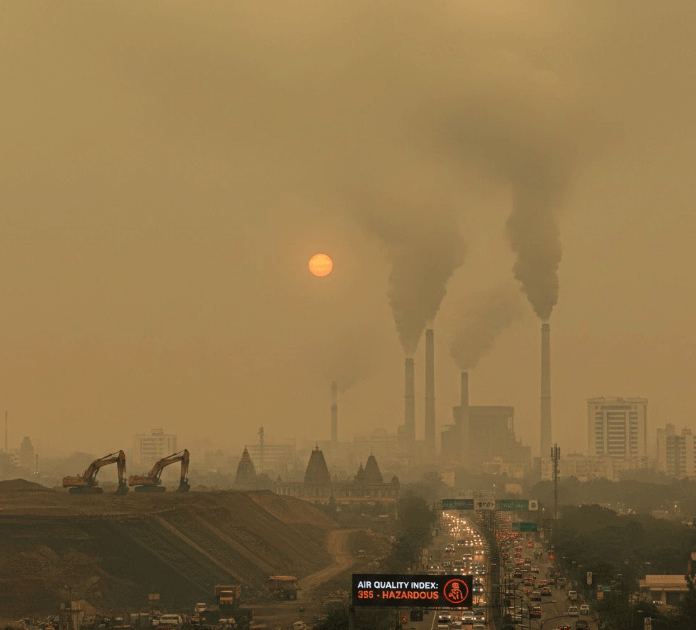
Bhubaneswar: The surge in air pollution across Odisha is a systemic crisis driven by the intersection of industrial expansion, mining intensity, and rapid urban growth. Unlike traditional pollution centers that may rely on a single dominant cause, Odisha’s crisis is characterized by a layered causality where each factor compounds the other.
The primary driver of hazardous air quality in regions like Talcher and Angul is the sheer density of coal mining and heavy industry. Talcher, home to one of India’s largest coalfields, experiences constant particulate matter dispersion from open-cast mining activities. These processes—ranging from drilling and blasting to the mechanized transport of coal—release massive quantities of PM10 and PM2.5. Furthermore, the concentration of thermal power plants and steel industries in the Angul-Dhenkanal-Jharsuguda belt contributes a significant load of sulfur dioxide and nitrogen oxides. The management of fly ash, a byproduct of coal combustion, remains a critical challenge, as poorly contained ash ponds allow fine dust to be re-suspended into the atmosphere during high winds.
In the urban corridor of Bhubaneswar and Cuttack, the narrative shifts toward rapid, often unplanned, urbanization. The transformation of these areas from low-density “green cities” to high-density concrete hubs has led to the systematic removal of green lungs—forest patches and wetlands that naturally filtered air. This loss is coupled with a massive explosion in vehicle ownership. The reliance on internal combustion engines, including a large fleet of older commercial vehicles and diesel generators used for power backup in commercial complexes, creates a persistent urban haze. Road dust from the relentless pace of real estate and infrastructure construction adds a coarse particulate layer that keeps air quality in the poor to hazardous categories for extended periods.
Seasonality plays a decisive role in escalating the crisis during the winter months. A meteorological phenomenon known as temperature inversion occurs when a layer of warm air sits above cooler air near the ground, acting like a lid. In Odisha’s coastal and river basin topographies, this traps pollutants at the breathing level, preventing them from dispersing vertically. Combined with low wind speeds, the toxic output from nearby industrial clusters and city traffic is held in place, leading to the dense smog observed in late 2025 and early 2026. This period also sees an increase in biomass burning for heating in rural and slum areas, as well as the seasonal impact of post-harvest agricultural residue burning in peripheral regions.
Despite the existence of the National Clean Air Programme and state-level environmental mandates, there is a visible gap in enforcement. Many construction sites operate without mandated dust suppression measures, and small-scale industries like brick kilns often bypass emission norms. Waste management remains another structural failure; the lack of scientific landfills leads to frequent open-burning of municipal solid waste, which releases highly toxic chemicals into the air. While the government has introduced measures like the mandatory Pollution Under Control Certificates (PUCC) for fuel access, the infrastructure for monitoring and immediate intervention in industrial zones has not kept pace with the scale of the emergency.
The current environmental emergency in Odisha is not merely a seasonal occurrence but the cumulative result of a development model that has historically undervalued the ecological cost of industrial and urban growth.