

Bhubaneswar: As the final sun sets on 2025, Odisha stands as a state caught between the echoes of its storied past and the loud ambitions of its future. The year drew to a close not just with the administrative milestone of its first female Chief Secretary, but with a deeper, more complex realization that the transition of power is merely the beginning of a much longer journey.
From the sacred, newly inventoried vaults of Puri to the quiet, disconnected villages of Malkangiri, the state has spent these twelve months testing the foundations of its new political and economic order. While the massive investment figures and the spirit of Odia Asmita offer a blueprint for a prosperous 2036, the departing year leaves behind a citizenry that is more watchful and demanding than ever before.
The year 2025 has etched itself into the history of Odisha as a season of profound transition, where the initial euphoria of a new political era met the sobering complexities of governance. Under the leadership of Chief Minister Shri Mohan Charan Majhi and the Bharatiya Janata Party, the state navigated its first full year of double-engine governance. This shift away from over two decades of regional party dominance brought a new administrative rhythm, aligning the state more closely with national policies while attempting to honour the local identity known as Odia Asmita.
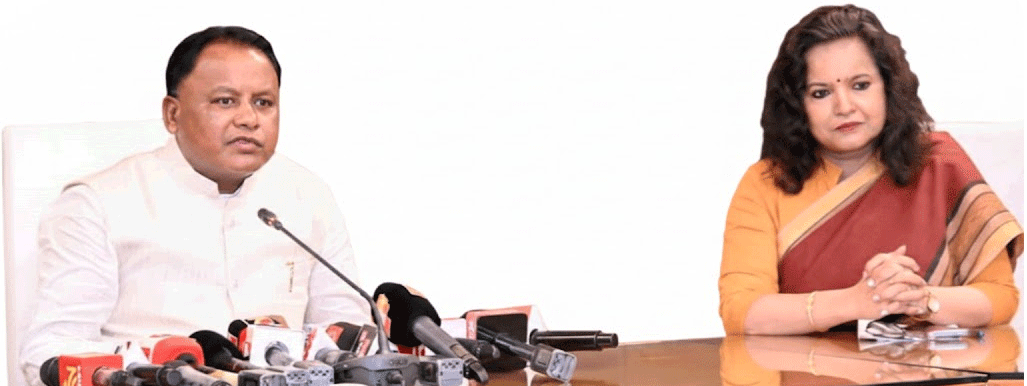
In the hallways of power, the year concluded with a landmark achievement in gender representation. Senior IAS officer Shrimati Anu Garg was appointed as the state’s first woman Chief Secretary, succeeding Shri Manoj Ahuja. While her elevation was a breakthrough for the bureaucracy, it occurred against a backdrop of public concern regarding the safety of women.
However, this administrative glass ceiling being shattered stood in stark contrast to a deteriorating safety environment for women across the state. Statistics discussed during the September legislative session painted a grim picture, with thousands of crimes against women reported within just over a year of the new government. The rising number of rape cases and high-profile incidents of harassment, including some inside police stations, sparked statewide protests and led to a growing public perception that the law-and-order machinery was losing its grip.
Legislative sessions in late 2024 and 2025 highlighted a big rise in reported crimes, leading to statewide protests and a demand for a more robust law and order machinery.
Economically, Odisha showcased a narrative of high-velocity ambition. The state outpaced the national growth average with an estimated rate of 7.2 percent, driven by a resilient mining sector and a surging manufacturing base. The Utkarsh Odisha Conclave in January 2025 was a crowning moment, securing investment commitments totaling 16 lakh crore rupees. However, the true challenge remained the immediate translation of these astronomical figures into jobs. As educated youth continued to migrate in search of opportunities, the State Government faced increasing pressure to bridge the gap between industrial promises and local employment.
The political landscape reflected this period of adjustment. The Biju Janata Dal, long the titan of the state, found itself grappling with its new role in the opposition. A surprising third-place finish in the Nuapada by-election signalled a potential erosion of its grassroots dominance, while the Congress party struggled to find its footing in the shifting tide. Meanwhile, the BJP Government focused on fulfilling electoral vows, most notably through the Subhadra Scheme, which aimed to provide direct financial empowerment to millions of women across the state.
Politically, 2025 was a year of consolidation for the new government. The administration focused on fulfilling its initial electoral promises, most notably the implementation of the Subhadra Scheme, which provided financial empowerment to millions of women. While the ruling party sought to solidify its grassroots presence, the opposition, led by the Biju Janata Dal, transitioned into a role of active scrutiny, frequently challenging the government on issues of administrative experience and the handling of localized incidents.
The political narrative was further enriched by high-profile visits, including a historic address by President Droupadi Murmu to the Odisha Legislative Assembly in November, where she outlined a vision for the state leading up to its centenary in 2036. Culturally, 2025 saw a revitalized focus on Odia Asmita or Odia pride. The state hosted the 18th Pravasi Bharatiya Divas in January, bringing global attention to its heritage and investment potential. Major festivals like the Rath Yatra in Puri and the Konark Dance Festival in December were conducted with grander scale and improved tourist infrastructure. The government also initiated world-class upgrades for significant religious sites, including the Maa Samaleswari Temple, integrating spiritual tourism with modern amenities to attract a broader international audience.
Spirituality and heritage also took centre stage. After four decades of anticipation, the Ratna Bhandar of the Shree Jagannatha Temple in Puri was reopened for repair and inventory. By the end of 2025, a high-level committee began the meticulous task of a digital inventory of the Lord’s treasures. While framed as a move toward transparency, the process remained under intense public and judicial scrutiny due to past controversies over missing keys and historical assets.
The year was not without its internal trials. While proactive policing successfully dismantled extremist networks along the Andhra-Odisha border, localized tensions created pockets of instability. In December, the district of Malkangiri faced a prolonged internet blackout following violent village clashes over land disputes. This incident served as a stark reminder of the fragile nature of social harmony and the challenges of managing misinformation in the digital age.
Odisha exits 2025 having successfully laid the groundwork for change, yet the true measure of this era remains etched in the challenges of the year to come.