

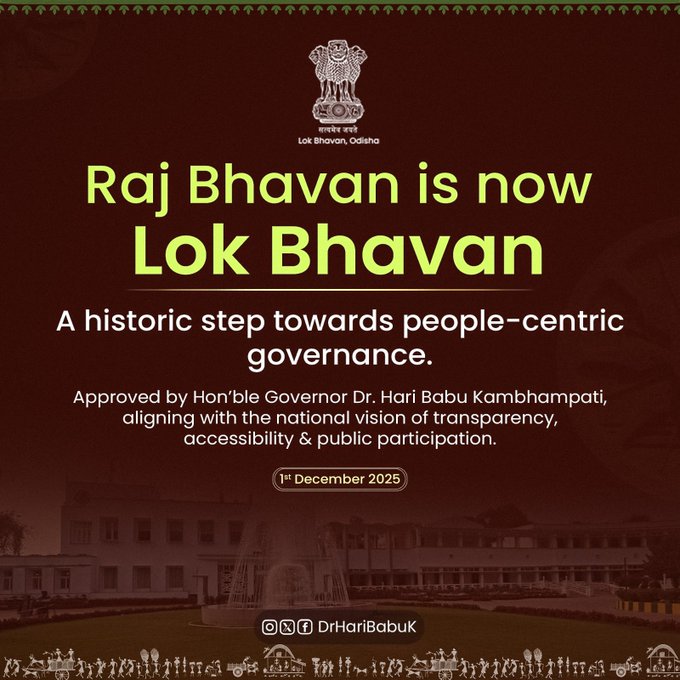
Bhubaneswar: In a move that signals a definitive break from India’s colonial past, the Governor’s official residences across the country, known as Raj Bhavans, are being formally renamed Lok Bhavans.
Odisha’s Raj Bhavan was among the first to formalize the change. Governor Dr. Hari Babu Kambhampati approved the renaming to Lok Bhavan, with a formal notification issued on Monday.
The Governor stated the new name reflects a commitment to greater public connection, transparency, and accessibility, echoing the broader vision of Prime Minister Narendra Modi.
This change is being implemented following a directive from the Union Ministry of Home Affairs (MHA), which aims to align the nomenclature of these key institutions with the spirit of Indian democracy.
The term ‘Raj,’ signifying ‘rule’ or ‘kingdom,’ is being replaced by ‘Lok,’ meaning ‘people,’ transforming the residences into symbolic “People’s Houses.” The MHA’s communication emphasized that the colonial terminology was no longer suitable for a sovereign republic built on the principle of popular sovereignty.
States like West Bengal, Tamil Nadu, Tripura, and Assam have rapidly followed suit, issuing their own notifications to adopt Lok Bhavan as the new official name. Furthermore, the official residences of Lieutenant Governors in Union Territories, previously known as Raj Niwas, are also being renamed Lok Niwas. Ladakh, for instance, has already made this change.
This initiative is being described by government officials as a significant milestone in decolonizing India’s administrative identity. The unified shift is intended to communicate a clear message: that the country’s governance structures are fundamentally centered on its citizens. While the symbolic change has been largely welcomed, some political voices have called for substantive reforms in the functioning of the offices to match the change in name.
The ongoing renaming process marks a collective national effort to embrace people-focused governance and instill greater pride in the nation’s democratic character.