

Bhubaneswar: In a decisive intervention addressing systemic grievances in Malkangiri, the Odisha government has formulated a comprehensive socio-legal framework to resolve long-standing land, educational, and livelihood disparities following recent communal instability.
Direct humanitarian assistance has been sanctioned to mitigate the immediate impact of the December incidents, reflecting a commitment to social justice. The family of the deceased, Lake Padiami, will receive ₹10 lakh from the Chief Minister’s Relief Fund. Furthermore, the administration has authorized financial aid of up to ₹75,000 for each damaged house and ₹20,000 for affected shopkeepers in M.V.-26 village based on rigorous loss assessments. Through these coordinated actions, the state seeks to restore the moral and structural balance of the district, ensuring that every citizen is protected by the precision of a responsive government.
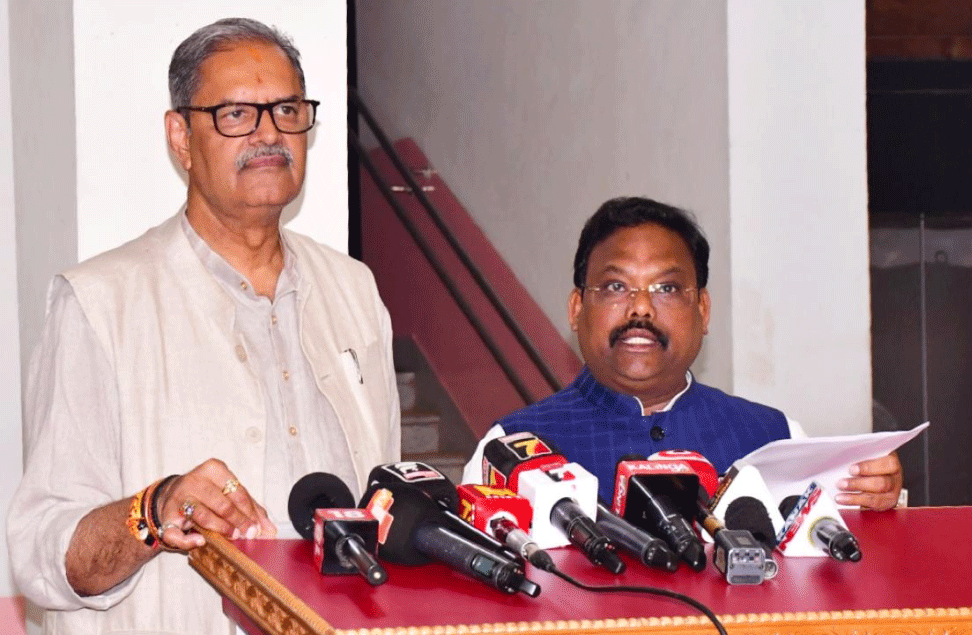
Deputy Chief Minister Shri Kanak Vardhan Singh Deo and Minister Shri Gokulananda Mallick, said to Media that the administration articulated a narrative of moral urgency aimed at rectifying the historical marginalization of tribal communities in Rakhelguda and M.V.-26 villages. This policy synthesis integrates immediate financial restitution with long-term structural reforms, ensuring that the state’s governance architecture directly addresses the layered causality of regional unrest through rigorous departmental accountability and quarterly executive reviews.
The government has mandated a fortnightly review of pending land cases under Regulation 2/56 to dismantle legal bottlenecks affecting tribal residents. To ensure permanent residency and economic security, the Collector will expedite the issuance of land titles under the FRA and OGLS Acts, while the Revenue and Water Resources departments collaborate to provide permanent pattas to families displaced by the Machhkund Irrigation Project. This commitment to territorial rights is matched by a developmental mandate to provide irrigation facilities to upland farms near reservoirs, effectively securing the agricultural viability of tribal lands.
Educational and economic integration form the secondary pillar of this systemic response, focusing on the preservation of indigenous identity and the expansion of opportunity. The School & Mass Education Department has been directed to immediately fill vacant MLE teacher posts for the Koya, Didayi, and Bonda languages, ensuring that primary education remains culturally accessible. Simultaneously, the state will increase higher secondary school seats and construct additional hostels to prevent student attrition after Class X. Livelihood security will be reinforced by streamlining tribal access to the Chief Minister’s Agriculture Development Scheme, PMEGP, and PMFME frameworks.